
Aaron McIntosh
Aaron McIntosh is a cross-disciplinary artist based in Montréal, Canada, where he is an Associate Professor in the Fibre and & Material Practices program at Concordia University. We first met in 2018 because of his Invasive Queer Kudzu project that cultivated community storytelling through quilted kudzu leaves that constituted an archive for the LGBQT South. Our conversation reflected on his work with Invasive Queer Kudzu, and discussed his current research and creation project, Hot House/Maison Chaude, as well as his writing on kinship.
The interview excerpts below have been edited and condensed for clarity.
Rachael Schwabe: If it wasn't empathy, what kind of words were circulating around that project for you?
Aaron McIntosh: Um, let's see…it won't just be singular words, but ideas. How to think about kinship beyond blood relation—thinking about kinship kind of the beyond human, like kinship with animals. Those are things that I actually believe in, I'm interested in—kinship with materials. So, I was kind of thinking about how, at least in my practice, kinship has a kind of materiality. Because when I go through the process of quilting and I'm often working with fabrics that bring their own histories with them, or they have their own connections to family and to physical blood family in my life, but also former lovers, close friends. Sometimes [if] it's a community textile, I call them that, like if I am working with a gay leather bar t-shirt that I found at a gay thrift store. There was one in Richmond where I used to live, others I've been to, or whether I buy it on the internet—it's working with things that are imbued with community-based identities. So anyways, [that’s] just sort of the way that I embed kinship at that level in the works that I make. And if I wasn't there to read the work or explain it to someone, maybe some of those things would get lost.
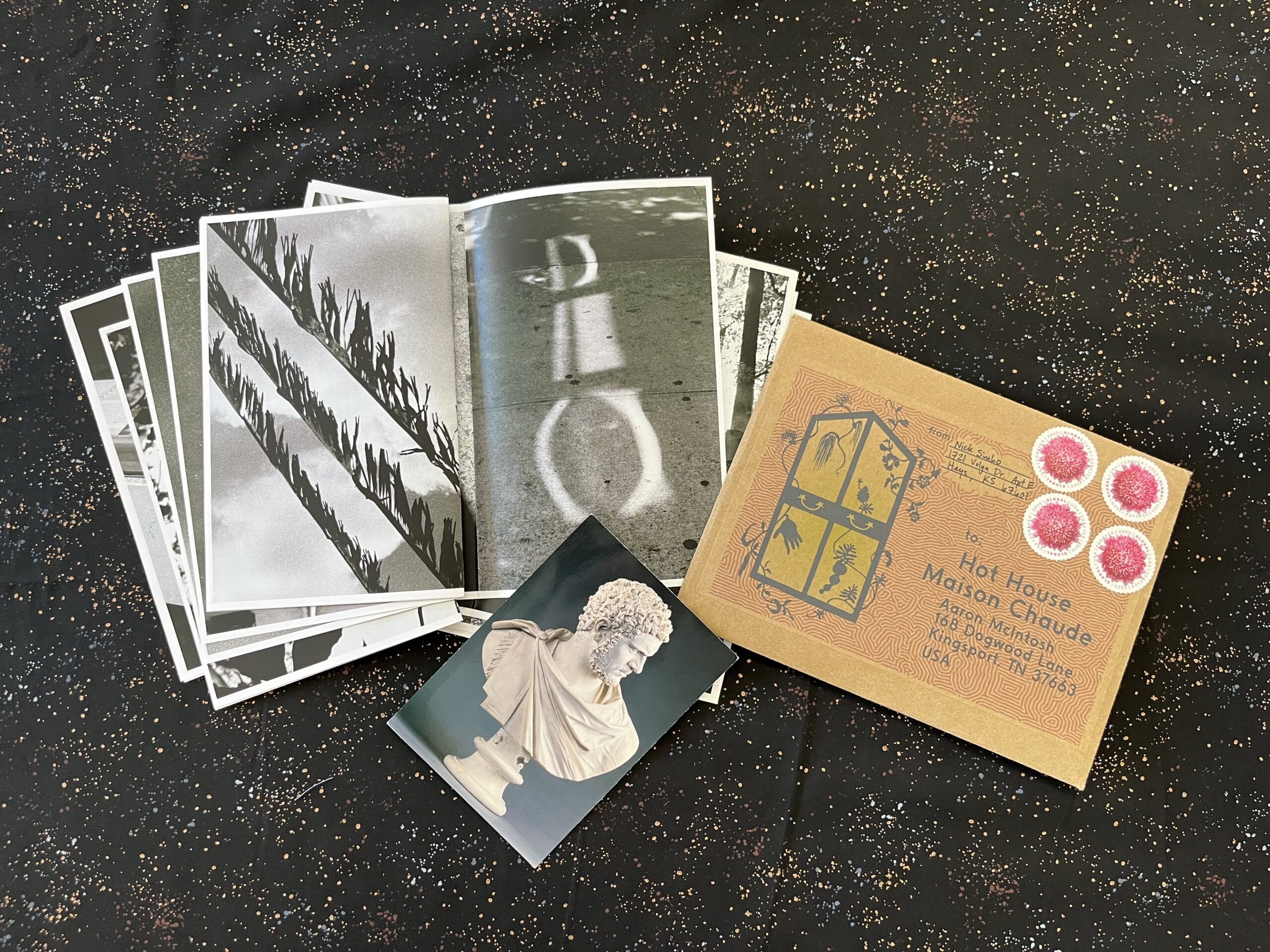
Q-Matter Participant Contribution, 2022.
Photo courtesy of Aaron McIntosh.
AM: I've been making queer compost for the last two years with material that comes from like queer people connected to me across North America. And in the last three months it has just entered into a public Facebook I had that's been many months in the making. But I emailed a thing about the project and a complete starter kit to people across Canada and the US. And that project is called Q Matter. Basically people sending in things that can be pulped in our organic materials and so we're making paper out of them. And then from these like tracings that I have, which are varying levels of legibility, so I cut the paper. The paper is also printed with like this stuff we call critter juice, the French word. It printed with that and it's basically a compost starter. There's like bacterial elements that are kind of screen printed with pigments under them and then they're cut. And then those things have been mailed out to queers across North America to, like, make their own compost.
RS: That's such a beautiful project, but I also think it has the same kind of theme of organism as your queer kudzu project.
AM: Well, it grows from it. Maybe this is where it does touch on empathy. The kudzu project has lots of notes of empathy in it. I don't really say that it's ended or done. I just say that it's dormant right now. I'm sure you've maybe thought about it, too, but I showed it in 2019 and I didn't think when you came to visit, it was literally a year before the pandemic would cause everything to shut down. I also ended up moving to Canada and actually I wanted to keep it going and there were some things that were going to be happening to keep it going through 2020, 2021. And of course, all those sorts of live community gatherings all got shut down because of COVID stuff. So, it's dormant. It may never have that element of it again.
But anyways, in its dormancy, I started thinking a lot about how to kind of build from that work. And there was always so much that I wanted to keep doing around this weird intersection of plants and people and weeds and belonging and otherness and place. So I started thinking a lot about, well, a bunch of different things related to that. But I had this idea to kind of start like further back from kudzu and its flourishing. I remember talking to you about this, and I haven't talked about in a while, so maybe I'm a little rusty. But a big metaphor to draw out of that project was this idea of queer people in the South, which has a lot of inhospitable or homophobic legislative things that have only amped up and honestly gotten worse. This idea of something flourishing, thriving, claiming, reclaiming, or invading maybe of its own space in the face of [an] inhospitable environment. And I started thinking about, well, what is it that makes for queer resistance, or what makes for queer vitality? So then I started thinking a lot about nourishment. I remember thinking and articulating a lot when I would talk to people about how I saw the queer archive in the kudzu [project]: there's community stories in the present and then there's voices from the past. But I always saw that the archival ones [as] a kind of way of talking about nourishment [for] a queer president or a queer future. And anyways, I just started thinking a lot more about that and kind of digging into other readings and other thoughts and I landed on compost. The compost kind of grew into thinking about propagation and cultivation and the other side of the wildness of the weed, but also thinking about how to intervene with cultivation.
RS: This project is trying to pin down that slippery thing of what is empathy? How do we feel it? How can we trace it? How can we make it traceable? And I think it's so interesting in terms of your kind of idea about or your work right now with kinship and materiality—how do we make empathy legible or like how does it become legible through process? Or how do we know there is something there with kinship, with or without [it being labeled].
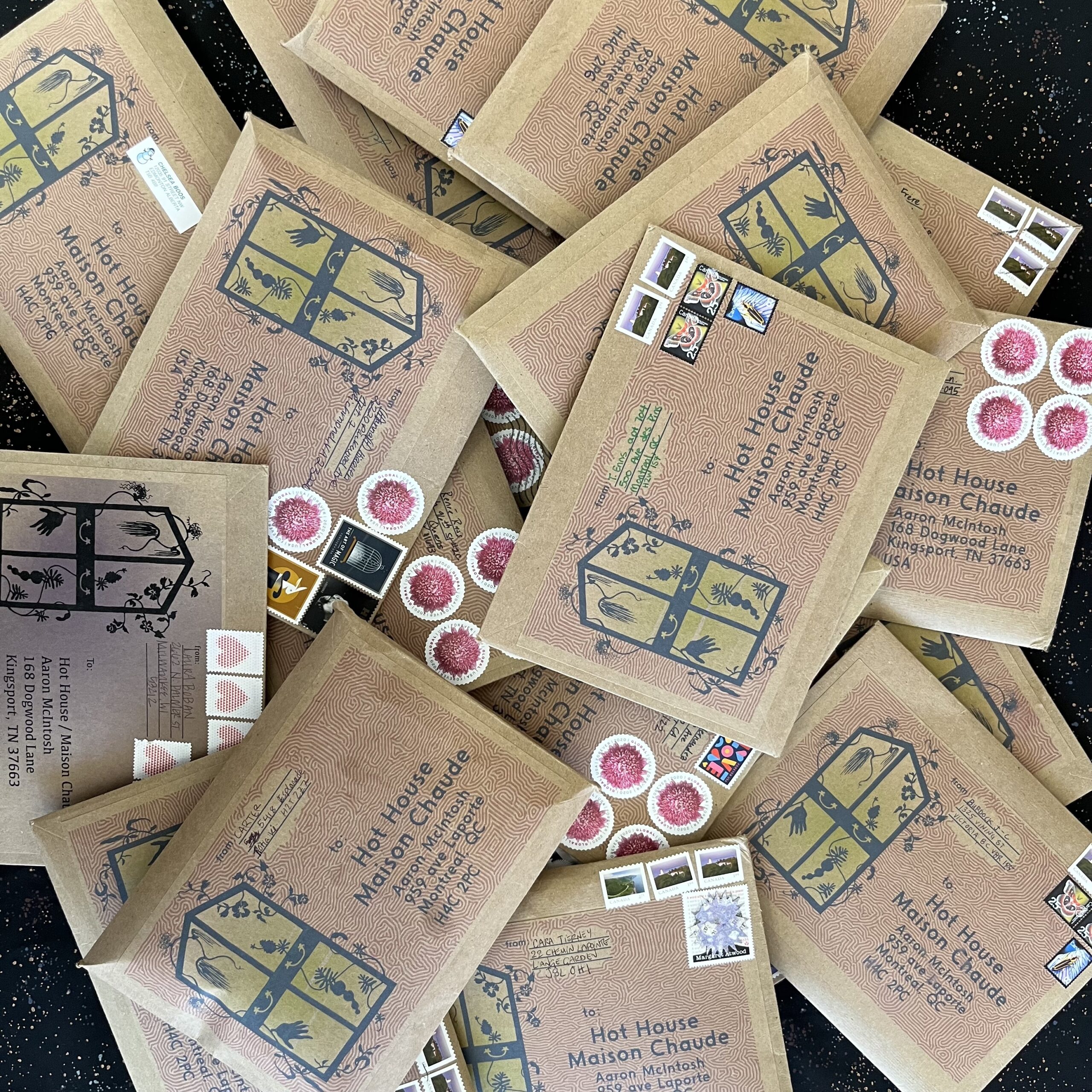
Q-Matter participant contributions.
Photo courtesy of Aaron McIntosh.
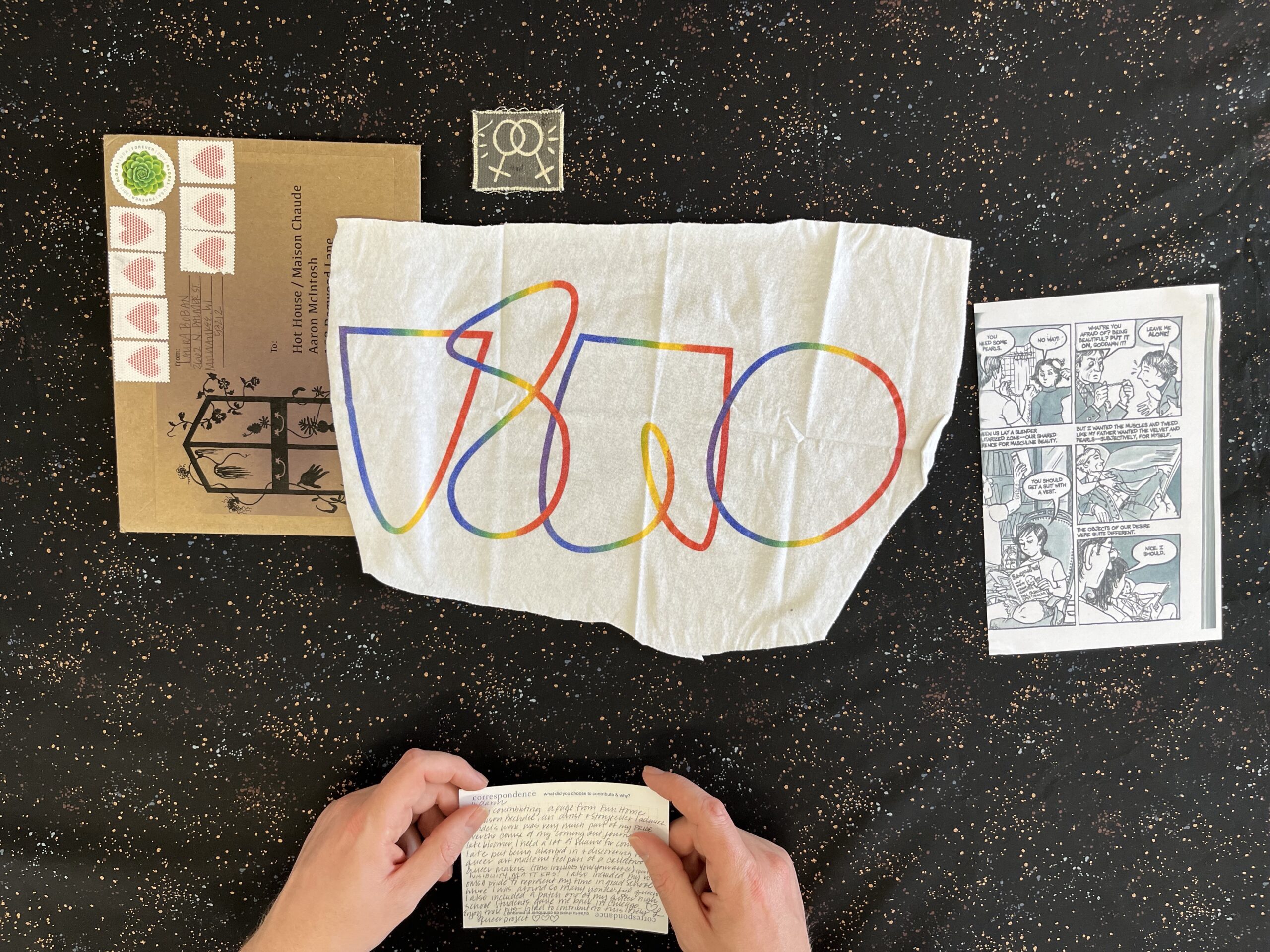
Q-Matter participant contribution, 2022.
Photo courtesy of Aaron McIntosh.
AM: I guess trying to just be more actively empathetic in my thoughts around resources like art and empathetic towards the earth. How I can be like a bit more collaborative with the natural world and other resources that it produces in the physical objects and processes and practices and collaborations and stuff that I do. And I'm around a lot of colleagues here at Concordia who do some pretty deep work around these kinds of things. They're writing this manifesto on exhibition guidelines and how exhibitions themselves could be like more sustainable and have less impact on our natural resources and less of things like that. So, I think that's where I've been thinking a lot about empathy.
AM: One of the still lifes I made is about that relationship and something that's entered my teaching and is a kind of sidebar from working with plants and compost and this hothouse project. I have started teaching natural dyes in a way that I never thought I would and both for environmental sustainability reasons, and health and safety reasons. I had to deliver a lot of textile courses, dyeing, and printing online over the pandemic. And I didn't want my students doing chemical dyes at home. So it was a lot of research and video making and stuff to get them to get set up in their home studios. And it's actually kind of left quite a few marks on me and my practice. I've been thinking a lot about empathy towards the physical space that I reside, and the still lifes I made is some of the pigments that I harvested from where my studio is located.
[As] someone who grew up with a lot of deep connections to the land and [I grew up with an] understanding of it as a [source] of bounty, but also understanding how to respect the land. Everything has like a second use or second life. We never threw vegetable scraps or eggshells or anything like coffee grounds away—they all went into a compost pile and that went into the garden later. These aren't necessarily new ideas to me, but I think something I had taken for granted in recent times being a city dweller. And now not owning a car [I’ve been thinking about] my imprint on various resources.

Aaron McIntosh, Still Life for Parc Pitt, 2022. Photo courtesy of Aaron McIntosh.
You can actually see the little addresses like, "Parc Pitt." And this kind of touches on a number of different things. It's the place where I harvested this goldenrod, elderberry, and grape vines. Local grape vines that you typically let dry or desiccate for a year and then I will make charcoal out of them from a traditional recipe for vine black ink. This place called Parc Pit is a gay cruising park. It's like where in the summer and fall, men go to have sex in the woods. [I am] interested in it as a little bit of a commemoration of like a, like a queer space. It's a kind of active queer zone. And the physical material of these as materials, that they were once living things, that they maybe are still living things but charged differently. I'm interested in their transmutation from wild plant things to art materials that are also imbued with queer energy from a place.
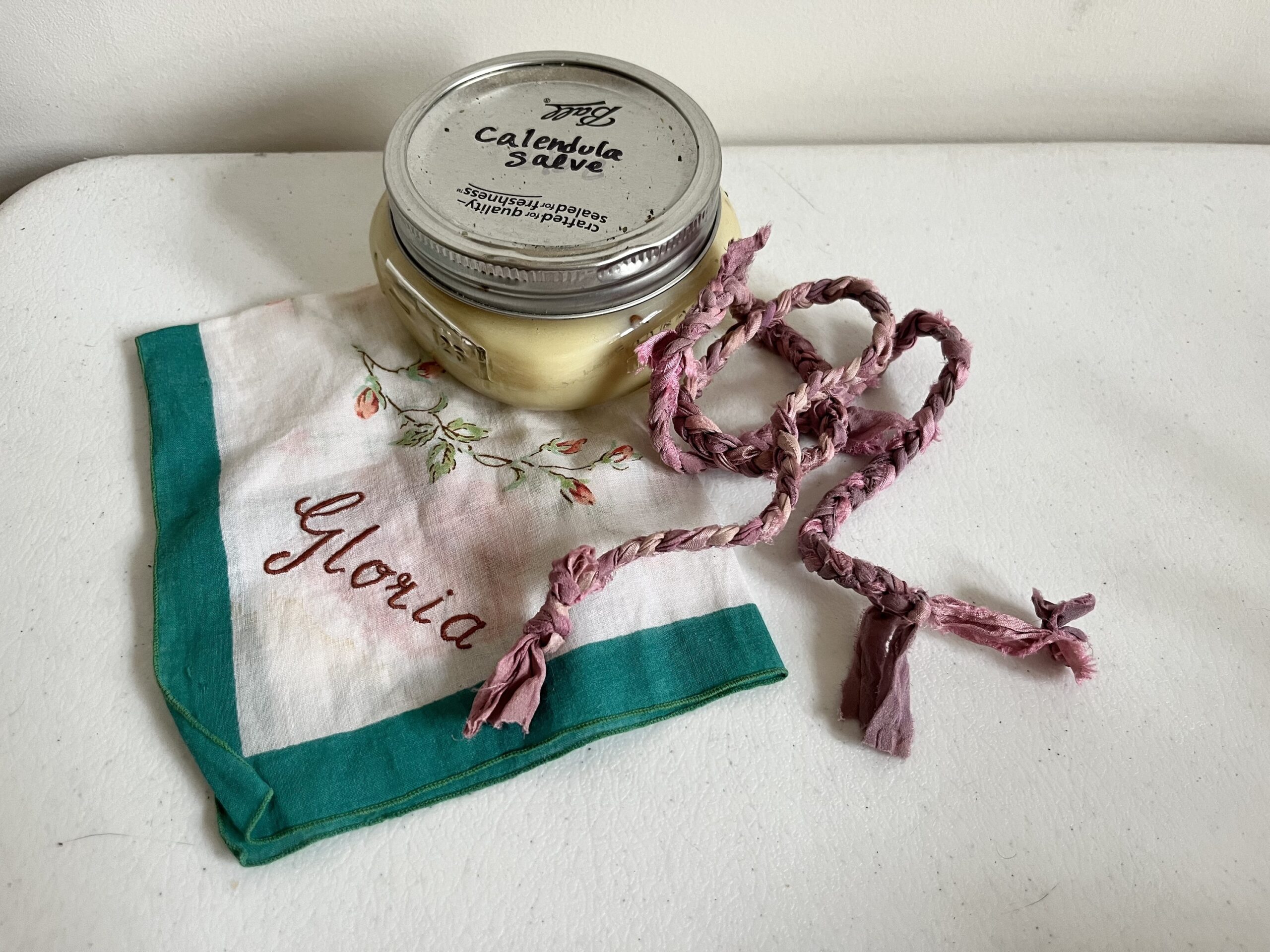
Aaron McIntosh, Still Life for Tallu Scott Quinn, 2022. Photo courtesy of Aaron McIntosh.
AM: One of my closest friends who I went to undergrad with, Tallu Schuyler Quinn, passed away two months ago from brain cancer. She did a lot of extremely empathetic things for this very close friend circle of hers. We call ourselves the circle, it's about 20 people. She's the one who's dying and in need of a lot of care and support. But she did all these extremely empathetic things for those of us that she would leave behind. She gave us all a handkerchief that many of us didn't even think [of as being] future forward, that it was actually a useful thing to use, when we buried her and had her funeral.
When we were in undergrad our teacher [gave us] an assignment [we] had to buy ten yards worth of different kinds of fabrics and dye them all on the same dye just to see how what we called color [and] dye uptake on different fabrics. We then we traded scraps and stuff like that among each other. But there was so much fabric that we all just had hanging around.
Tallu got her diagnosis of breast cancer in June of 2020 and passed away in [the] middle of February 2022. During that 20 months or so she started going through this pile of silks and cutting them into strips and just braiding little links of rope to give to this group of people. It was one of her preoccupations—making use for these things that she felt like no one would ever really quite appreciate in the same way that she did. It's just beautiful to be on the receiving end of that and then to be part of this like empathy circle—seeing her record of stuff and being able to recognize little elements from those fabric piles and paper making piles that she had 20 years ago when we were in undergrad together.