
Marisa Finos is a sculptor and multimedia artist based in Providence, Rhode Island, where she is also a ceramics instructor at The Steel Yard and The Artists’ Exchange. I first learned of her body of work when she was shortlisted for an Emerging Voices Award by the American Craft Council in 2019. Ever since, her interest in using clay as an “extension of her own body” and her interest in funerary practices have clung to my mind. We discussed her intimate relationship with her materials and her process of making and destroying her vessels, as well as the boundaries and boundlessness of empathy.
Rachael Schwabe: What draws you to vessels and the vessel structure? How did you arrive at that place or from?
Marisa Finos: I've been doing ceramics, or working in clay, since high school and I'm 36 now—so, it's been a while. I've always been interested in working with the body and trying to relay the human experience and connection. And I've always been interested in portraying the figure in some way or working with the figure in some way. I started out doing more realistic figurative sculpture and more intimate sculptures. And to be honest, I just like felt like it wasn't enough after a while. I was like, "cool, I'm good at this, I’m good at sculpting a person." And it didn't really move further than that for me, so I removed more of the actual figure from my work and started using my own body and working with the vessel itself to be a metaphor or a replacement for the human body. Especially being a ceramist and working in clay we're taught [that] the vessel is the first thing you learn about and [learn] how to make. The vessel is a metaphor throughout history and time and objects: vessels in service to the body, or a vessel is a body in language terms, and really just playing with those ideas and metaphors. I wanted to address how my body could activate a vessel, or a piece like that and talking about a vessel as a container of space to allow connection and to inspire connection.
RS: The vessel too, I think is quite literally a conduit for a lot of the things that you do in terms of sound and enclosures and creating scenarios of intimacy, which I think is just so lovely. But there was also something that struck me in watching the video that you sent me. There's one part where I think you are kind of smoothing out the side of your vessel and you talk about the clay as flesh, and this is actually something that I've written about in terms of Janine Antoni’s work—licking and gnawing and all those kinds of things, the way objects can embody the flesh of the artist. I’m just so drawn to that process, [and it’s a] thing I notice you’re doing as well. Have you always viewed [clay] quite as your kind of extension of your flesh?
MF: You know it's probably something [that happened when] I made the conscious decision to move away from the figure. I started thinking about clay more as like an entity or like its own being, and treating it more as a human material—clay is so human. And that's why I'm so drawn to it in my work. It records every emotion and touch and pinch and pull; it records my existence and my body and my interaction. It's so alive and emotional. And you really do have to have a relationship with clay as a material so you can work with it and not against in. In that case, like I think it's such an empathic material to work with. You really do have to listen and be present and be like "oh, OK, like I can't force it to do its thing." Clay has been such a huge teacher for me as an artist and as a human—learning to work with it and when to let go and when to be vulnerable and when to let it show its imperfections. I think it's taught me to be like a way more empathic person and it's a constant reminder that we're so impermanent too. Clay in its raw stages is so fleshy and it's malleable like our bodies. When it goes through the firing process, it's permanent like bone and it becomes calcified and it like has the ability to live on through death.
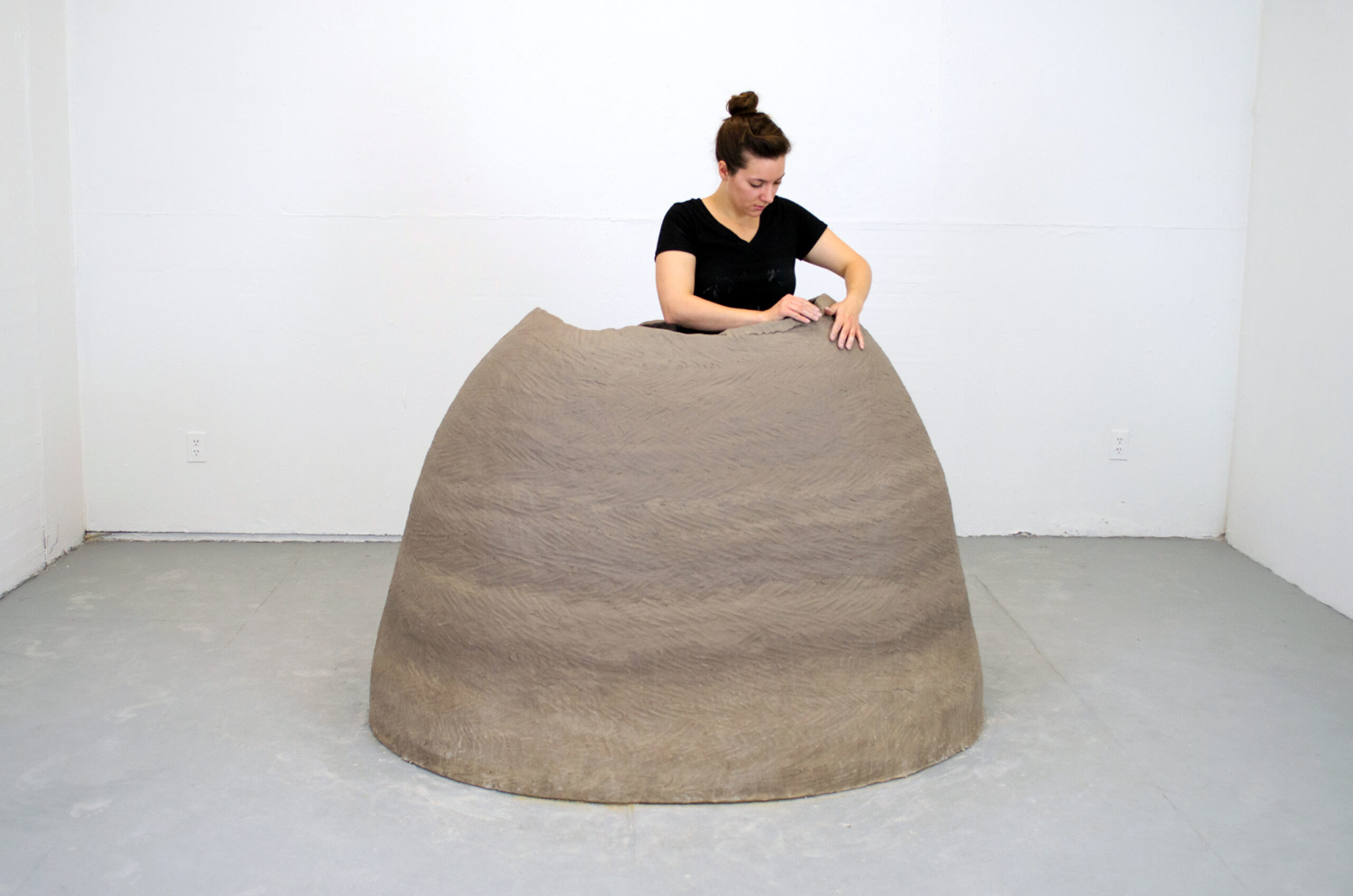
Marisa Finos, Vessel III (with Harriotte), 2015. 5-Day Durational Performance. Clay, Sound. 63” L, 50” W, 45” H. Photo Credit: Jenny Calivas. Photo courtesy of Marisa Finos.
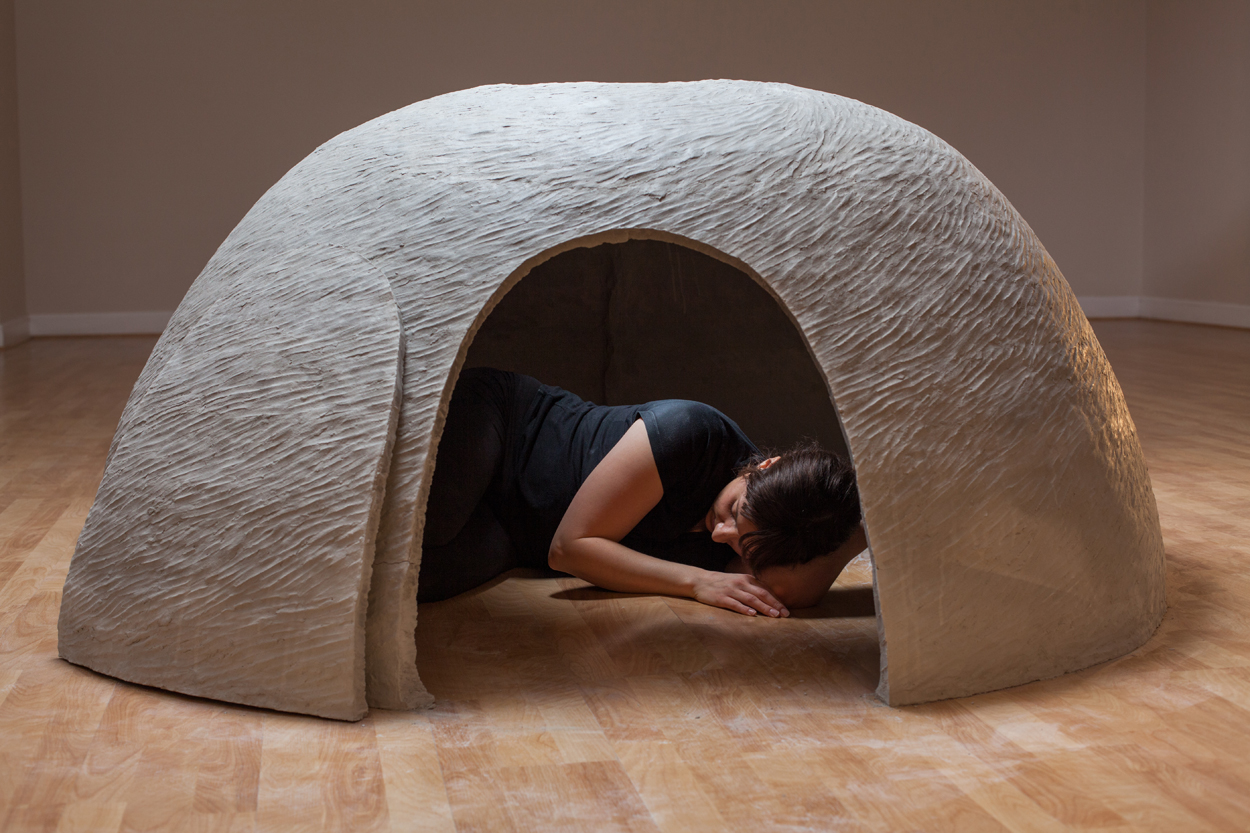
Marisa Finos, Vessel IV, 2015. Performance. Clay, Sound. 34” H, 70” L, 68” W. Photo Credit: Janelle Proulx. Photo courtesy of Marisa Finos.
RS: What I appreciate about your vessels is the way that they record your marks and the way that you've made them. They almost like they look like they've been woven. I think [this quality] allows people to really connect with it and inhabit the work because it's so visceral. Communion is a word that [is] circulating around this project, but maybe we'll go back to this idea of empathic materials, or what does empathy mean to you?
MF: Yeah, you know I had to look this up, especially when you were comparing sympathy and empathy, because they're so close. But one requires a lot more work in action, and I think empathy is just so much about making a conscious and intentional decision to connect with another person and imagine what they could be going through and how you can remove yourself to wholly show up for another person. Empathy is just like a way more—it requires so much more action. Sympathy feels more, not performative, but less action-based in terms of this is me and how I relate to you.
RS: Yeah, true. I'm an instructor for design history classes in New York City and and sometimes like I'll e-mail students who are going through various things and I'll say, "I can sympathize with your situation," and I think that it's interesting for me to think about the sensitivity around these words and how I'm using them and also to draw particular boundaries between my relationship with my students. Like maybe I would say I empathize with my friends.
MF: I love [that] you're using the word boundary. That's so much what it's about, yeah?
RS: Yeah, I think that's true. Sympathy is about keeping up some kind of boundary, whereas empathy to your point, you have to remove yourself in order to become whole. You have to kind of dissolve your own ego.
MF: Yeah, that's ah, that's so interesting. Because I teach ceramics—I teach community classes at a bunch of different places, mostly wheel throwing and hand building—and I will say it's been really interesting, especially during the pandemic, to have people come in with whatever terrible thing they're dealing with in day and watch them either be in line with the process of making or fighting it. Depending on where they're at that day, watching them learn how to embrace it and how to let go with that material, which I think is a great metaphor for how to be empathetic to yourself and how things are hard to navigate.
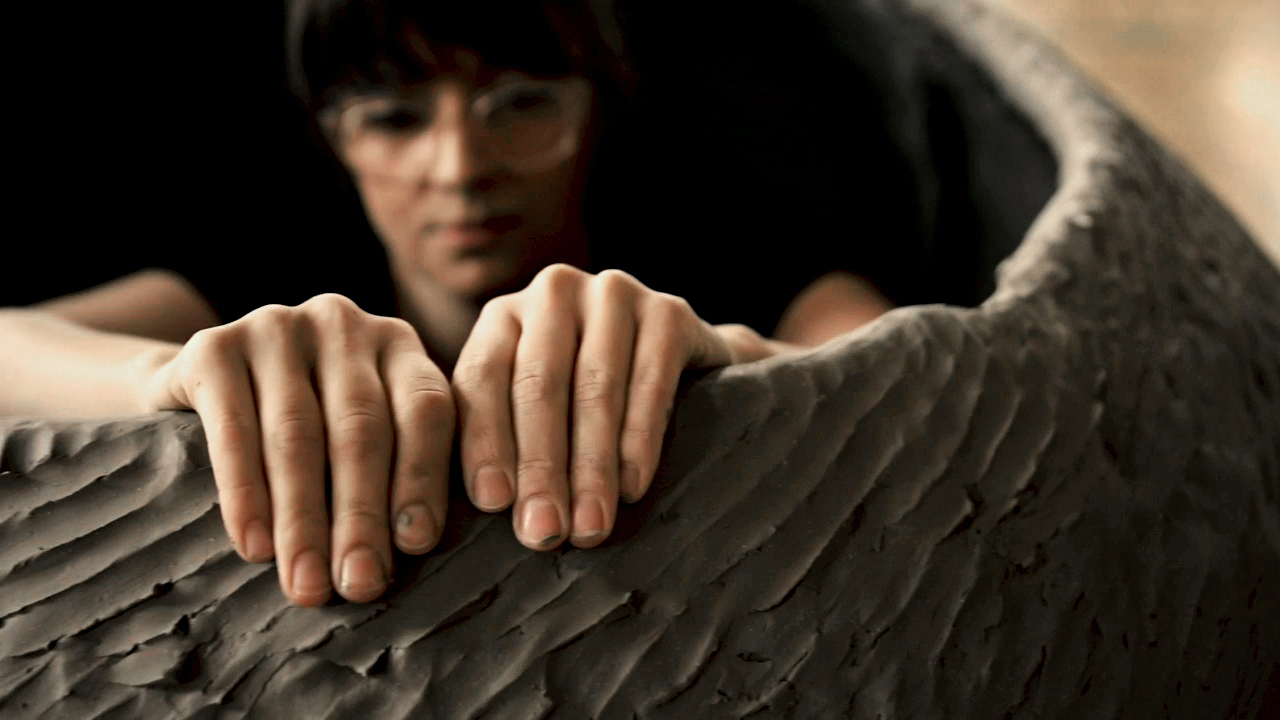
Marisa Finos, Vessel V, 2019. Clay. Video documentation of 2 hour performance, 4:03. 46" L x 46" W x 38.5" H (Object). Video/Photo Credit: Dannie Harris. Photo courtesy of Marisa Finos.
MF: I think I've always been a more empathic person and I feel very fortunate to come from a family where we talk about our feelings. Being in service to others has always been very important and showing up for others has been very important. I've just weirdly have been in situations and jobs where I've had to be at the bedside of a dying person. And it's just been a lot of practice, I think just being present. Also working with children is a huge teacher in being present with that little person and just like acknowledging their innate needs in that moment, and applying that to like everyone.
RS: I come from a family of physicians: my mom has been a nurse and both my dad and my stepfather [are] doctors. I chose a different path. I have such admiration for people who work in care industries. Especially having done some nannying myself, in doing that work [I found] it is really hard to maintain that level of empathy and care for another person. To vacuate yourself pretty consistently in order to be there for someone else. It can be really exhausting or really depleting. I wonder if you've also felt that way.
MF: At least like from my own experience, sometimes helping others is a way to distract me from helping myself. And when you're really good at caregiving and like doing what you do like, it can be a trap too because everyone counts on you or there's a lot of pressure on you. In terms of exhaustion, I feel that so heavily in my work when I make these vessels—it is a huge act of labor that I do. I have to disconnect pretty hard after I make my work because I'm in it for like a week, 24/7 and I put my body through hell and I'm also doing so much thinking and contemplating about my own life and existence and what it means to be doing what I'm doing. I almost can't talk about it, I can’t look at pictures of it for a while.
RS: I wonder what you think about when you're building a vessel.
MF: I'm working one layer at a time, and I can't see the piece as a whole. Also, a lot of improvising goes into this work, because stuff changes or I have to adjust to things and cracks happen or it doesn't dry in time. With every coil I’m thinking about my own existence. I do a lot of stuff that's like, "this is pointless, why am I doing this?" Or like, "I'm just going to destroy this thing, it's a temporary object and I'm killing myself to do it." And like, "why does that matter and why is this important to me?" When I'm making this work, I think other people too are like, "you're kind of nuts, like that's so much." In terms of mending or repairing—you can apply it to yourself, right? I just feel like it’s an important action to show building and creating an object that another person can either relate to, or just have them question their own stuff.
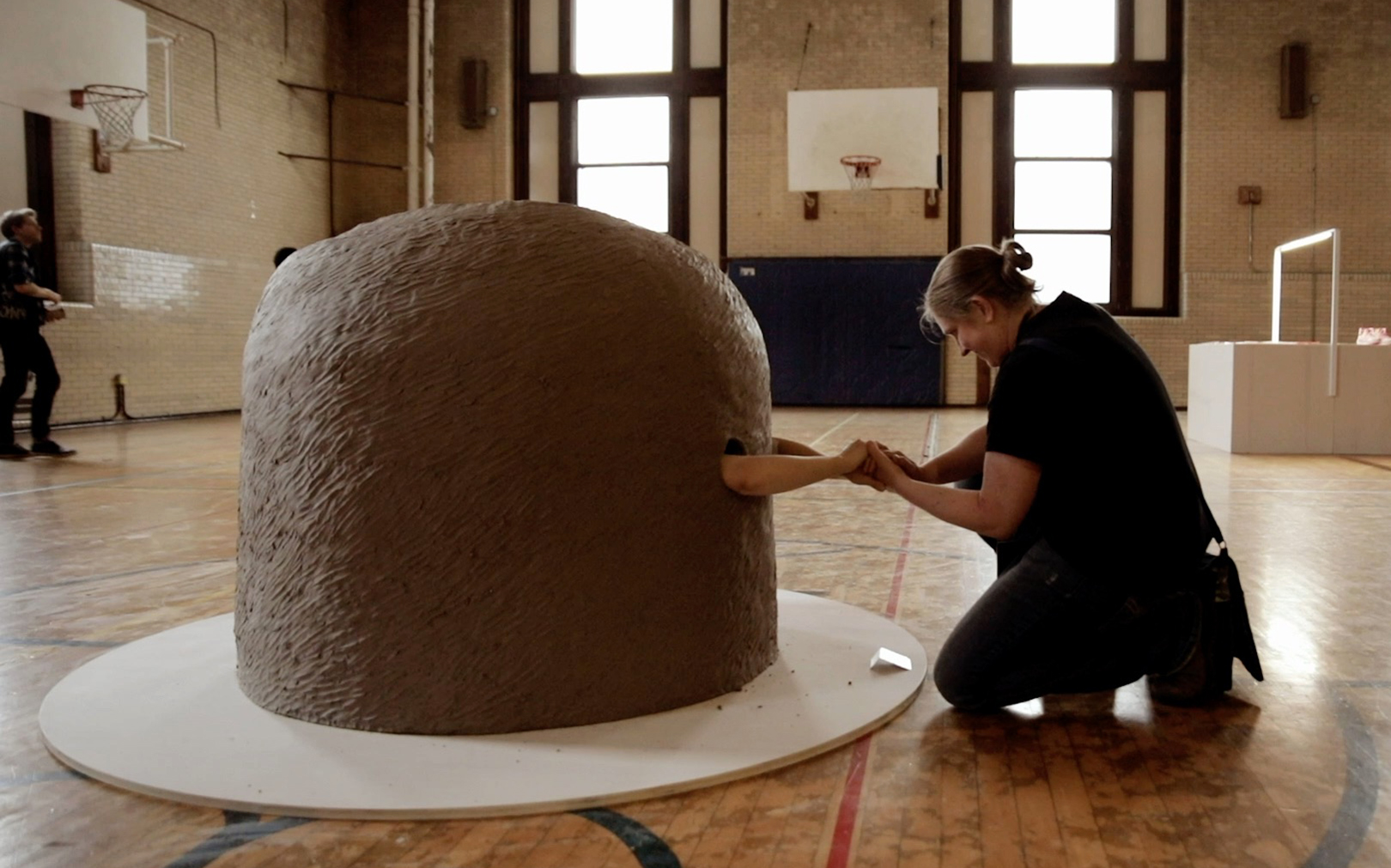
RS: My fixation lately is how do we touch objects? How do they touch us back in really literal ways, but also maybe more metaphysical or metaphorical ways? I think that Vessel 5 that you shared—that's such a specific instance [of] an object like touching you back because your arms are through it and you're holding on to people. In the documentary footage there were a lot of women who approached [you, but] you couldn't have known that because you couldn't see them. But I think that that's also really interesting in terms of who’s…open to feeling that vulnerability or willing to step into that kind of space?
MF: Yeah, absolutely. Thinking so much about the mending stuff and like making an object for another person or fixing an object for another person. And also working in a material that other people have been conditioned not to touch in a museum or a gallery setting. I love that people want to touch my work and I'm OK with them touching—I want them to touch my work. I want them to feel what the clay feels like and feel my finger marks and also touch me. I want to connect with people. It was really interesting doing that exercise with that performance because I had no plan for the piece. I was like, "I'm just going to try and offer a gesture and see what happens and nothing might happen and that’s the piece too." I was just so moved by the people that chose to hold my hands, some of them I knew and some of them I didn't. I've never felt so much love, it was just wild when you remove all your other senses or some of your senses—how much more present you could be in like receiving emotion just through touch? It was very powerful; it was way more powerful than I thought it would be.
Every piece or every vessel that I've made has been a container for me to understand my connection to other people and so they all become very specifically tailored towards how someone chooses or doesn't choose to interact with me, or if it's actually physical or passive interaction. But the vessel just oddly becomes this instrument that reverberates, magnifies everything I'm feeling inside because I'm alone in there or it's an actual space where I can be like, "oh, holy crap, I'm really paying attention to this feeling right now because I'm not distracted by everything else."
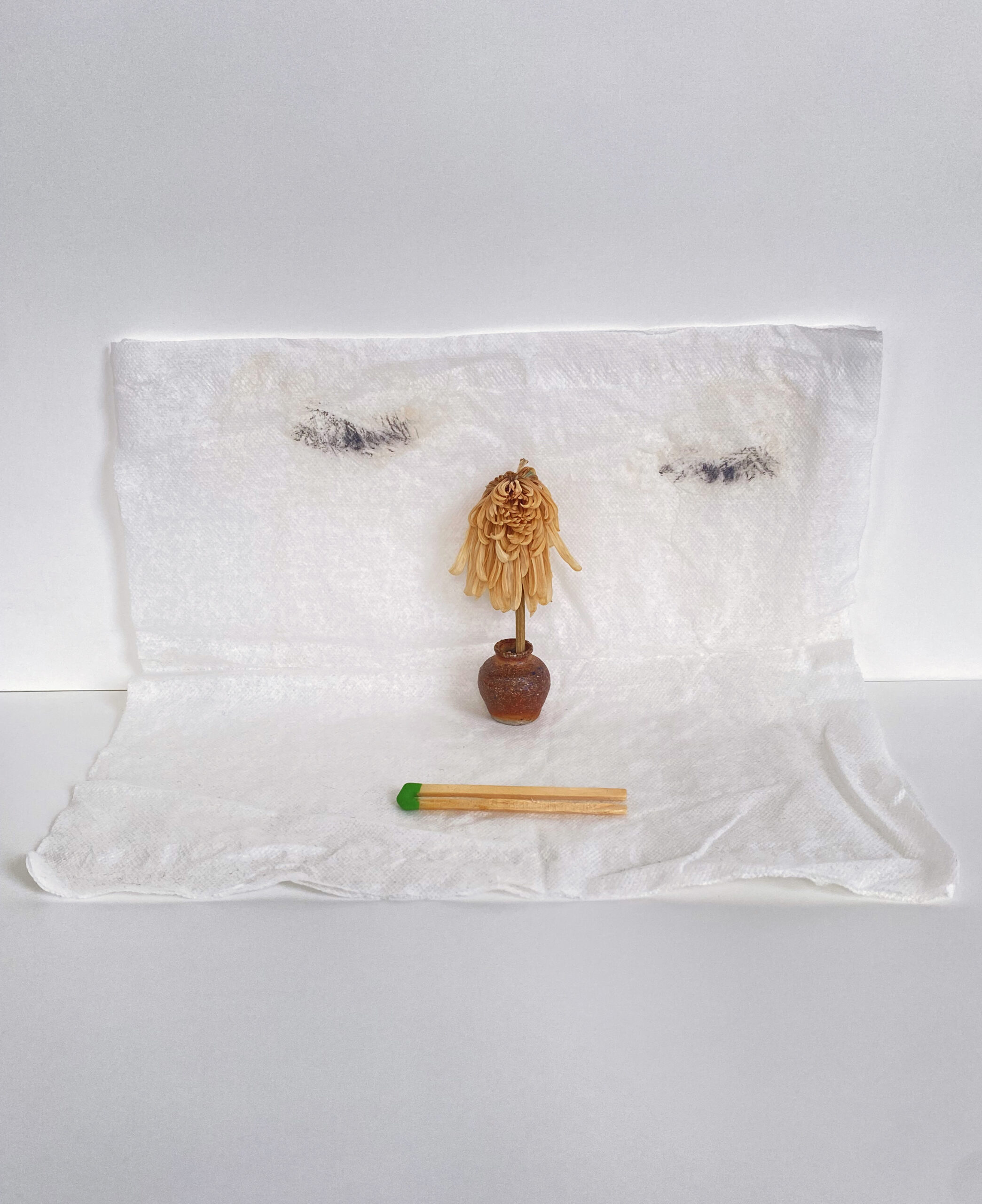
Marisa Finos, Still…Life, 2022. Photo courtesy of Marisa Finos.
- Facial tissue memento from the most immense cry I’ve ever experienced. It documented my mascara, foundation, and tears.
- Tiny clay vessel made by a friend.
- Dried flower from my aunt’s funeral.
- The perfect match (two matches bonded together).
—Marisa Finos, 2022
Marisa Finos Statement
Clay is skin, flesh, and bone. It bruises, bends, and breaks. Like the body, it is constantly in flux, able to disintegrate into dust, or calcify into permanence. For me it is an extension of my body, and a means to explore both its fragility in life and what endures after death.
Vessels is an ongoing series of large-scale site-specific clay sculptures investigating the bodies and spaces we create, inhabit, and leave behind. Inspired by ancient and contemporary burial structures made to honor, protect, preserve, and guide the deceased to the afterlife, each vessel is hand-built coil by coil, following the parameters of my own body. Throughout the week-long building process, using anywhere from 600 to 800 pounds of clay, I eventually entomb myself. From within, I use the vessel as a space to further understand my own body and the connections I have to others through isolation, darkness, sound, and vibration. The vessels become transformative portals to contemplate the edges of bodily existence. After my experience inside, I destroy the vessel and reclaim the material, giving it another life.