
Rachael Schwabe: Do you have a practice currently or anything that you're doing with regularity?
Shannon Palmer: No, though I was taking a drawing class. If anything, I probably enjoy collaging the most, but it's not something I do.
RS: What do you enjoy about collaging?
SP: I like that there are really no rules. A good collage is just what is good to me, and like meaningful to me. I don't really seek outside feedback on [my collages]. And I like the materiality, and it really plays into what I identify as an extra love language, which is seeing something that reminds me of someone else because my brain loves to make connections.
RS: I think the joy that I have with [collecting images on] Instagram is making symmetries between images and the material world. I like the way that you're talking about collage as being able to make your own rules, and that you can feel things out, what clicks and makes sense for you—like you are operating by your own mathematic sequence.
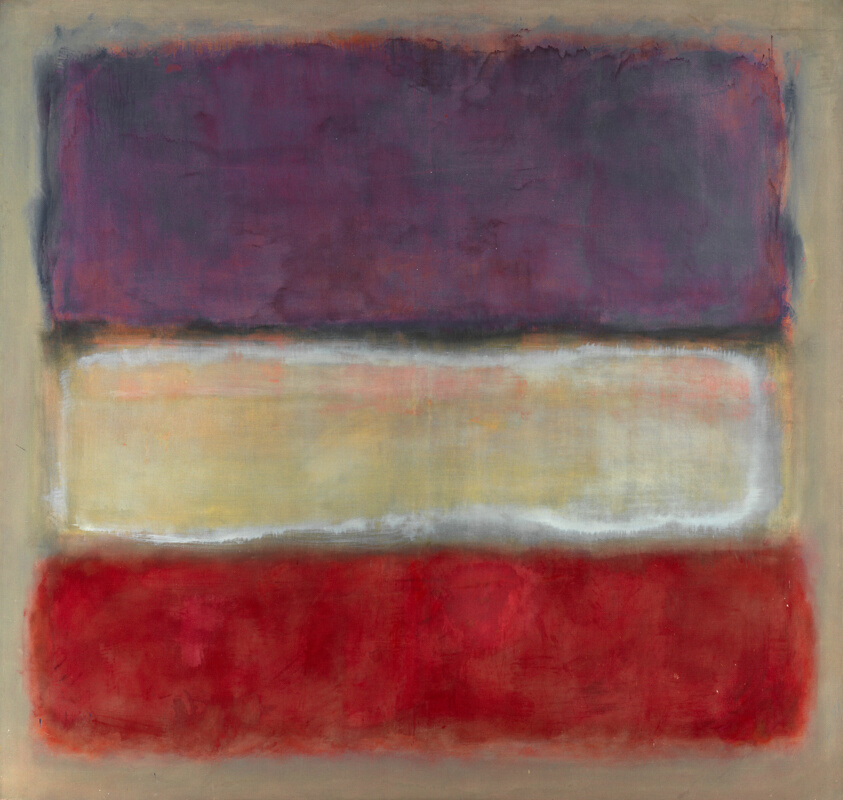
Mark Rothko, Untitled (Purple, White, and Red), 1953. Oil on canvas. Art Institute of Chicago.
RS: What do you associate with the word empathy? Do you think that's at all connected to any things that you've done or work that you do?
SP: I mean, I think it's grounded in the empathy that I have with the people in my life. Empathy is all about genuinely connecting with another person or a situation as a whole. And to me it feels like collaging is also grounded in the connecting, or like you said, finding the symmetries between the material world, and even the emotional one. I think I've always been a person that's been like "I only cry"—well, American movies really help me cry because it's an external way to channel feelings. When I first started studying art history in high school I learned about the artist Mark Rothko and it kind of felt like an instruction book of how to feel your feelings in public. And it's like, "how does like looking at this combination of colors and thinking about color theory—what kinds of emotions does this illicit for a person or for me?" I think Rothko's [works] have always held that for me. Rothko and romance movies—you know, things that feel good, but also feel bad. I can really get riled up in channeling my feelings into the physical world.
RS: Visual art that like unlocks these doors for us in ways that we can't do on our own. I had a similar feeling about Jackson Pollock—a highly problematic person—but when I was in high school and taking AP Art History, I just was so enraptured by the physicality of his paintings. The bond they have with the artist and the way that they quite literally reflect his movements and his deliberations and the materials of his studio. It's so powerful. I have other artists who do that for me now, but you never forget the first one who did that for you.
SP: Through therapy, I've been trying to focus on myself again and really asking myself, "what do I want like, does this bring me joy? If not just don't do it?" I'm learning there's much more choice than I thought. The way in which I've felt empathy most recently is for myself—being kind to myself and forgiving myself. Today I was like "you know what, I'm going to buy more underwear and more socks because like I will be so annoyed in the morning when I can't find like a good pair of socks to put on." And today I was like, "you know what, you're just going to treat yourself and you're going to buy more because it's fine." I had to figure out how to be like be kind to myself and be like, "you actually don't have to suffer in this way."
RS: Yeah, I could definitely learn from you.
SP: Is that empathy? I don't know.
RS: I think that's empathy. The key word to me for empathy, or the key synonym, is the idea of feeling into your future self: what she's going to feel and how is she going to be able to live. You want to support her because she's you, you're caring for yourself in the present and yourself in the future.
SP: Yeah, it's what I've tried. I think it's hard though. It's easier to have empathy for other people than it is to have empathy for yourself. It is always the easiest for me to channel my feelings to connect with another person. But that’s another thing, to take care of yourself.
RS: Yeah, you know you can be just a circuit of one, a circuit within yourself.
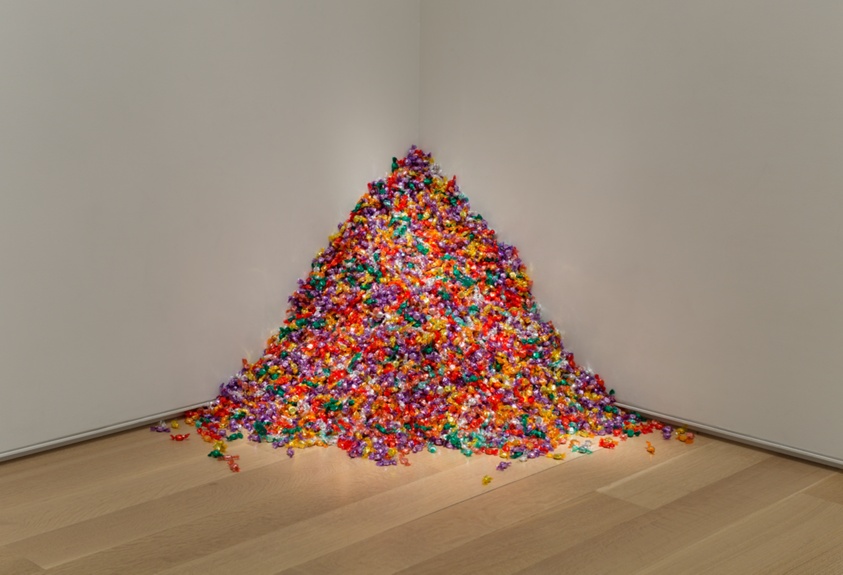
Félix González-Torres, "Untitled" (Portrait of Ross in L.A.), 1991. Candies in variously colored wrappers, endless supply. Dimensions vary with installation; ideal weight 175 lbs. Art Institute of Chicago.
SP: I think it's so interesting that you're focusing on things that are physical representations of the body and of once being.
RS: [In Félix González-Torres’s Untitled (Portrait of Ross in L.A.)] Ross is like a communion, you are almost taking the body of a man. I grew up taking communion at church. But it seems like that taking a piece of candy that is representative of someone deceased, to me is like even more real than the body of Christ.
SP: If you could take some other form of communion, what would it be?
RS: When I was younger, I went to church with my family more often [than I do now]. The Holy Thursday Mass for Easter at my family's church was beautiful because what you would do is process [the aisle] and Someone ahead of you would wash your wash and dry your hands and then you would turn to the next person behind you and wash and dry their hands. It’s intimate. I remember doing it both for family members, but also for strangers. I can think of communion in terms of, what if everyone was making a sweater or something, or you had just one sweater that everyone contributes like a stitch to, like someone starting the loop and someone else like finishing the sequence. What about you? What do you think?
SP: I think in a way it is the same as like collaging or sending someone something, or buying someone something.
When I was in [Learning and Public Engagement at the Art Institute of Chicago] I would throw every single going away party. And for me, it was a way that I love celebrating people. My mode of decorating would be like: OK, there's balloons. But it's also how can I find things that remind me of you? It just makes you feel really seen. It's like I would want my own funeral to be—something where people just bring something that reminds reminds them of me. Almost in the same way it's kind of like a collage.
RS: I didn't know that about you and that's really special. Also, I can imagine that would be so exhausting to keep up that standard.
SP: It's always so fun because it's something that like my brain has always done it at all times. I can't get through a day without like seeing something and thinking about someone else, or thinking about an experience, or even like smells. Sometimes I'll go back into the Ryan Learning Center, and I'll be like “Wow, it still smells the same.” It brings back very specific memories. All I do all day is just like think about something. I was like reading the New York Times newsletter this morning and I forwarded it to my dad because I was like, "This is really interesting because we've had these kinds of conversations before."
