
What can crafted objects teach us about care, trust, and collaboration? And how might these same objects continue to perform as channels for affective and activist work, outside their maker’s control?
This project really began in the fall of 2019, when I first began researching my Qualifying Paper topic for my MA at the Bard Graduate Center. My primary focus was Janine Antoni’s body of work, in particular her performative objects and installations she created in the 1990s and early 2000s. Gnaw (1992), Loving Care (1993), Lick and Lather (1993), and Saddle (2000) all saw Antoni using her body to make impressions on organic materials like chocolate, lard, soap, and raw hide through actions like chewing, mopping, licking, and washing. Speaking about Gnaw in an interview for BOMB Magazine in 1999, Antoni said, “for me, that removal is a generous act, in the sense that it creates a place for the viewer. Imagining the process is so much more powerful than watching me do it…By imagining me, the viewer’s experience turns out to be about their own wish fulfillment.” I was struck by her awareness of the intimacy of her process and captivated by the invitation that her chewed cubes of chocolate and lard presented for her viewers.
My fascination with Antoni’s work—and the resonances with Victorian material culture I identified in her approach—only grew through 2020 and 2021. I became fixated on my understanding of “craft” and “empathy,” the key concepts of my early conceptualization of Antoni’s artworks and performances, because they took on new and deeper meanings with the pandemic. In the summer of 2021, I realized I wanted to consider the connection between craft and empathy at a wider scale, and to locate that connection in contemporary makers and thinkers.
All conversations represented on this site took place over Zoom between April and June 2022. I sent each interviewee the same set of prompts and questions. Each conversation traced familiar paths—What is empathy? How does it relate to craft?—but each interview had hairpin turns that opened my line of thinking in new directions. All participants had the option to make or write about an "empathetic object" inspired by our conversation. Not everyone chose to respond to the making prompt, but every conversation felt rich and expansive.
With Gratitude
I have many people to thank for their time, help, and guidance around this project. First and foremost, I’d like to thank those individuals whose works and words are represented in this website’s archive: Aaron McIntosh, Irin Mahaparn, Kira Dominguez Hultgren, Marisa Finos, Rachelle Dang, Shannon Palmer, and Terri Friedman. I took immense pleasure in our conversations, and I feel that those represented here, whether we met in 2016 or 2022 are now close friends, colleagues, and collaborators. Thank you for your thoughtfulness and your willingness to think through craft and empathy together.
I also want to thank Lauren Cutshall, Coco Zhou, and Jordane Birkett, for your open ears and minds in the earlier stages of this archive project, and for helping me to see this project site through. And finally, I am grateful for the generous funds I received from the Bard Graduate Center’s Fields of the Future Institute that made this project’s realization possible. The support I have had from the BGC community has been unparalleled and continues to shape my perspective on the subjects at the center of this project: care, trust, and collaboration.
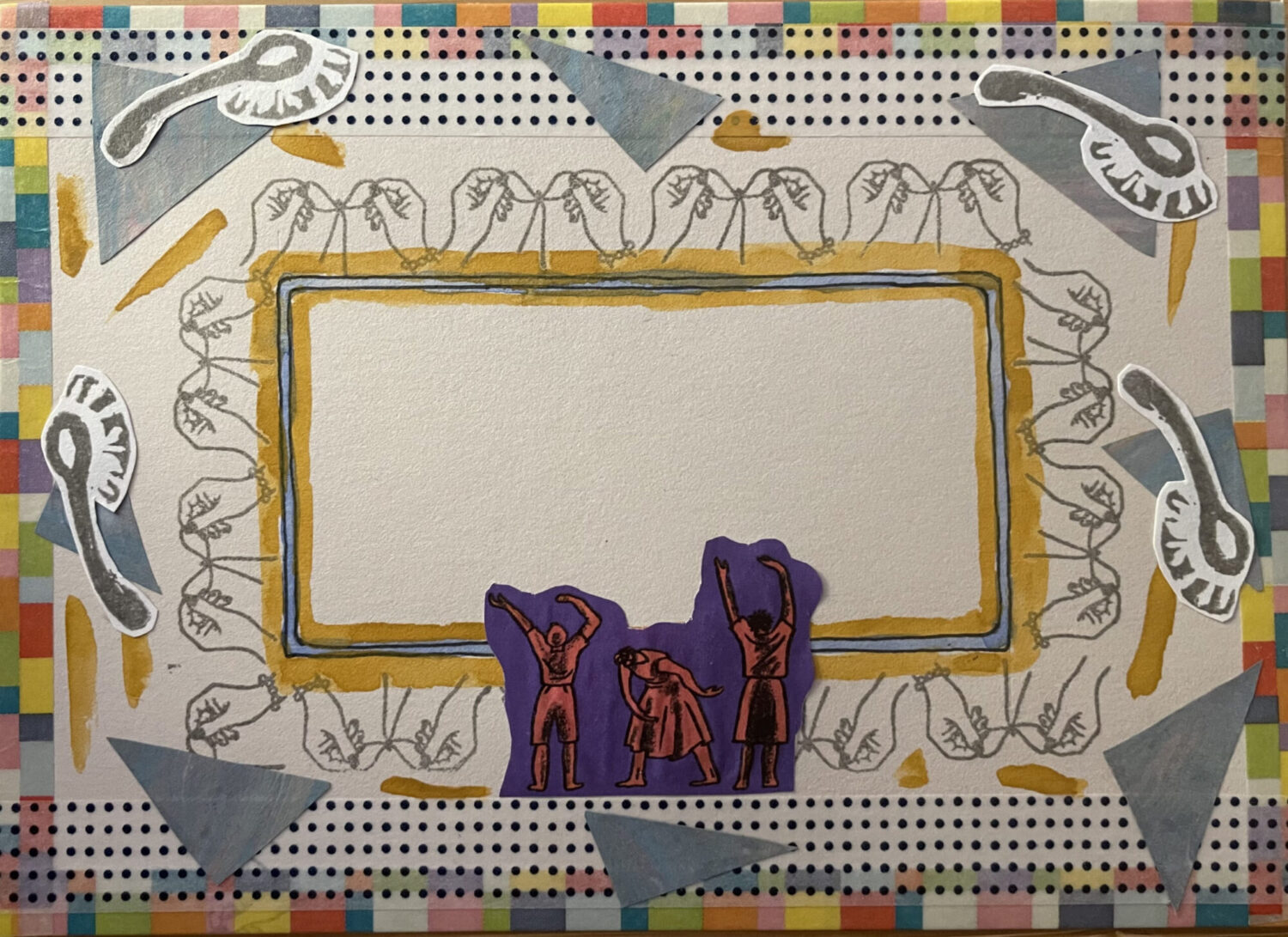
Rachael Schwabe, Crafting Empathy Collage, 2022.