
Terri Friedman
Terri Friedman is a weaver based in the Bay Area of California, where she also serves as an Associate Professor at the California College of the Arts. The first thing that I noticed about Terri’s tapestries is the palpable electricity between her warp and her weft. We talked about her painter’s mindset translates into works that envelop their viewers. We also realized how the words Terri incorporates into her tapestries embrace her viewers in the same way that the process of weaving “holds” Terri.
The interview excerpts below have been edited and condensed for clarity.
Rachael Schwabe: Where and how did you learn to weave, or how did you arrive at weaving?
Terri Friedman: I come from a painting and sculpture background. My work has always investigated how I can paint without paint. And in 2013 my family went to Barcelona, and I saw [Joan] Miró’s huge weaving at the Miró Foundation. I've been wanting to weave. I took a weaving class at school during that time with Lia Cook, she had been around a long time and was retiring and I wanted to take a class with her. I was in her last class and I fell in love with weaving. The school gave me a loom and I'm still using that loom. That was 2014. My practice slowly converted from multimedia kinetic sculptures at the time.
RS: I see a painterly sensibility in the surfaces of your tapestries.
TF: It's something I've thought about a lot—how do I place myself within textiles as a painter, so that's how I approach my fibers. I love weaving and I love craft and so maybe it's like the intersection of craft and painting. I still approach my materials as a painter, so I look at texture. I collect fibers and I have different textures and thicknesses. I really think of it as paint my material heartbeat and so when I go to weave, I'm painting.
RS: What do you usually think about while you're while you're weaving?
TF: Well, there's two things I think about: There's all the podcasts I listen to. I love the idea of empathy because I listen to Krista Tippett or 10% happier, and more—I listen to a lot of inspiring, empathetic people talking about the world and how to heal it. I’ll imagine a word that I often put in the weaving, and it becomes kind of an overall arc for the work. And then I think about the technical things. Those are the things I can do while I'm weaving because I grid out the whole piece ahead of time.

Terri Friedman, WITH, 2021. Facebook AIR, Virtual Reality Building Lobby, Sunnyvale, CA. 15’ x 20’. Photo courtesy of Terri Friedman.
RS: We've been kind of dancing around empathy a little bit, but what is your relationship to empathy as an artist or as a person?
TF: It's such a good question and I hadn't really considered my practice as empathic, but it really is. Empathy to me is listening and feeling to others and so it can be their heartbreak, their pain, but it also is like in Buddhism—I've done vipassana meditation for years—and that's one of the things I listen to my podcast, but I love the idea of sympathetic joy that you can feel other people’s joy too, so I think empathy is both positive quote and it's a heartbreaking and it’s hard. I think lately I've been trying because there's so much pain in the world and so much heart, it's just so dark right now and I think that any way there's friends listening to friends and family and my own empathy towards myself.
RS: It's been interesting to me to have these conversations because people tend to say kind of similar things around how to define empathy in terms of showing up for people [and] being present often [through] these signifiers of active listening or physically being there for someone. Lately I've also been trying to think about what role craft plays in promoting feeling. I think that fibers are a sensitive material; it can hold thoughts and feelings in addition to being kind of a utilitarian material, that it can capture all kinds of others matter as well in its form or structure or surface.
TF: [Woven] fabrics are part of our sleep and our loving and our caring, and we wrap blankets around babies and around old people and corpses. I think I've gotten success with [the woven object] because I think there is an empathic response. You’re probably right that people are drawn to [fibers] because that was maybe why I was drawn to Miró’s big tapestry in 2013. There's something about painting, which is very intellectual and kind of removed, and there's something so enveloping about a huge weaving—it was 60 feet by 30 feet—in a way that a mural couldn't be. So yeah, I think craft evokes a somatic body response [and] an emotional response and it brings up memories, I do think fiber [does] that.
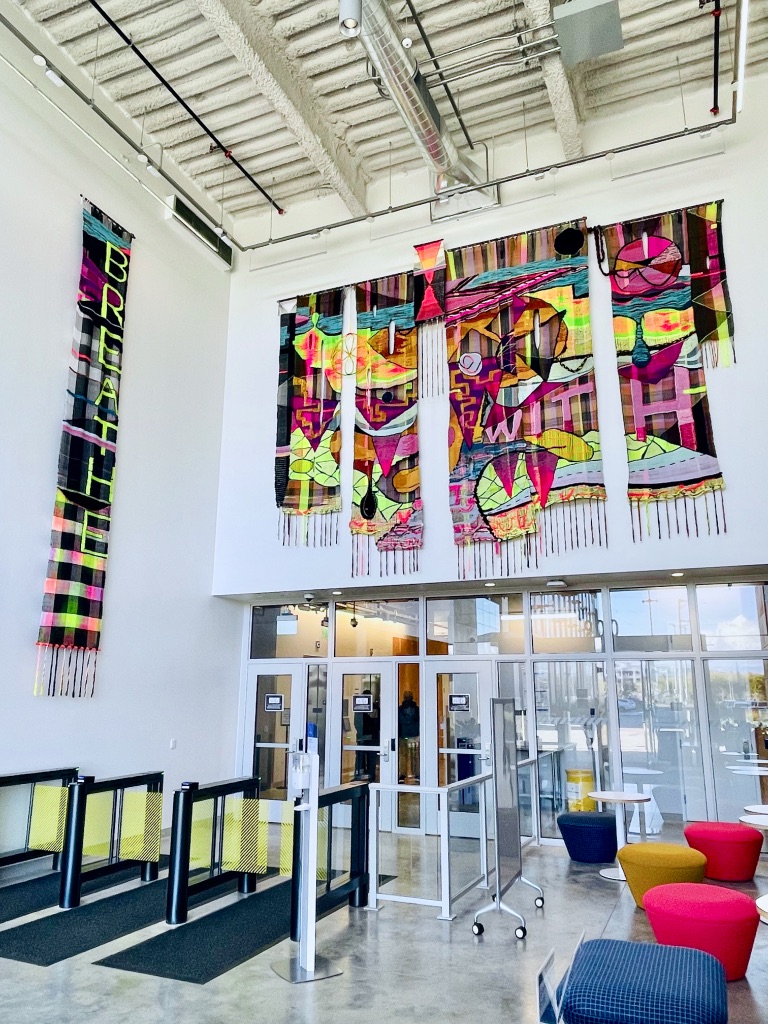
Terri Friedman, WITH, 2021. Facebook AIR, Virtual Reality Building Lobby, Sunnyvale, CA. 15’ x 20’. Photo courtesy of Terri Friedman.
TF: My cognitive behavioral psychologist once said that I was a highly sensitive person, which I think a lot of artists are, and so that kind of means that we [have] too much empathy. Like in some ways we have to because we see the world and we feel the pain and we make work about it… For me, my weaving is the opposite—it's a place of healing and of repair, it's not [the place] to go feel the feelings. It's actually to calm the feelings for me [through] that repetitive motion. [As] someone who is wired for too much empathy I have found weaving is my medicine. I do think that there [are] a lot of people [who] spend too much time upset over what's going on in the world and sometimes it's a very calming gesture, that kind of warp and weft, the back and forth. On a very personal level, I find the craft healing and kind of parental—like, “I'll hold you and I'll contain you...in your grief, and your heartbreak and all those feelings.” See for me, painting is a fast process, or it was much faster and so the pace of weaving is very, very slow. I think people feel that when they see a work that there's something about [that’s] slow, like investment in a piece. I don't know if some paintings have that, but most don't, and there's just kind of an investment with these details and this love and care and I think that people see that.
RS: The work is giving you something back in terms of this collaboration, you know you have all these feelings and they're being processed through this physical process.
TF: Yeah, it's structured. It's like a kid who's having a tantrum or [is] really upset and you just hold them. [Weaving] kind of holds me and it helps me. It's physical and kind of united between mind and body.
TF: Something that is really important to me to [is] this idea of generosity and giving people a [somatic] experience. The kind of work that asks questions or is more open-ended, is, to me more generous, and that's why I don't use a lot of words. I'll put in a word almost like a color, like a gesture, it's a suggestion, not a lecture. Like, “enough” can be either “I'm enough,” or “enough talk,” [it] can be really interpreted in so many ways, whatever the person coming to the work wants to finish the sentence. I want to create a really joyful, pleasant experience for someone. Again, it's weaving all the heartbreak and all this stuff into something that's hopeful.
RS: How do you come up with different words, or where do the words come in? Do they surface to your mind as you're working?
TF: Often the work is generated from a word. I collect words and phrases from books I read and when I read something really inspiring, I'll write it down. In the last [few] years it's been a lot about how to spin my anxiety about the world and personal issues into something livable [and] optimistic. Right now I'm working on [a] body of work [for a] show in LA next the end of next year. I was thinking about the four humors like sanguine, melancholy, phlegmatic, and choleric, and this idea of the four bloods–how important they are to all the emotions we feel, and all the constitutions we have. I want people to tell their own story. One piece I really love, said “If Only” and it was this idea about regret but also, “it doesn't matter.”
RS: That is a very generous act of leaving it open because I think it's also something both you and the viewer of your work can digest. You’re obviously digesting it in order to make [the piece], but I think in perceiving your work, you're offering up that same word, and then the word [becomes] the communion point for both of you.
TF: Totally, that's beautiful. The word is the communion and it's often camouflaged in, so it's a very quiet offering. “if you choose to think about this,” it's kind of a gentle nudge. I mean, some of them are much more graphic–I always think of Sister Corita Kent. She's my hero. I love what an activist she was, her work was so generous.
RS: Her work is really terrific! And you're touching on something that I really enjoy about craft is that it allows you encode messages both visibly and invisibly into like a work, and you can choose to make a very gentle offering or a prompting, or something even more invisible, and deeply encoded.
TF: It's like what I'm thinking about when I'm making the work: it's an investigation and then it's a meditation on that word. And then the object is done.
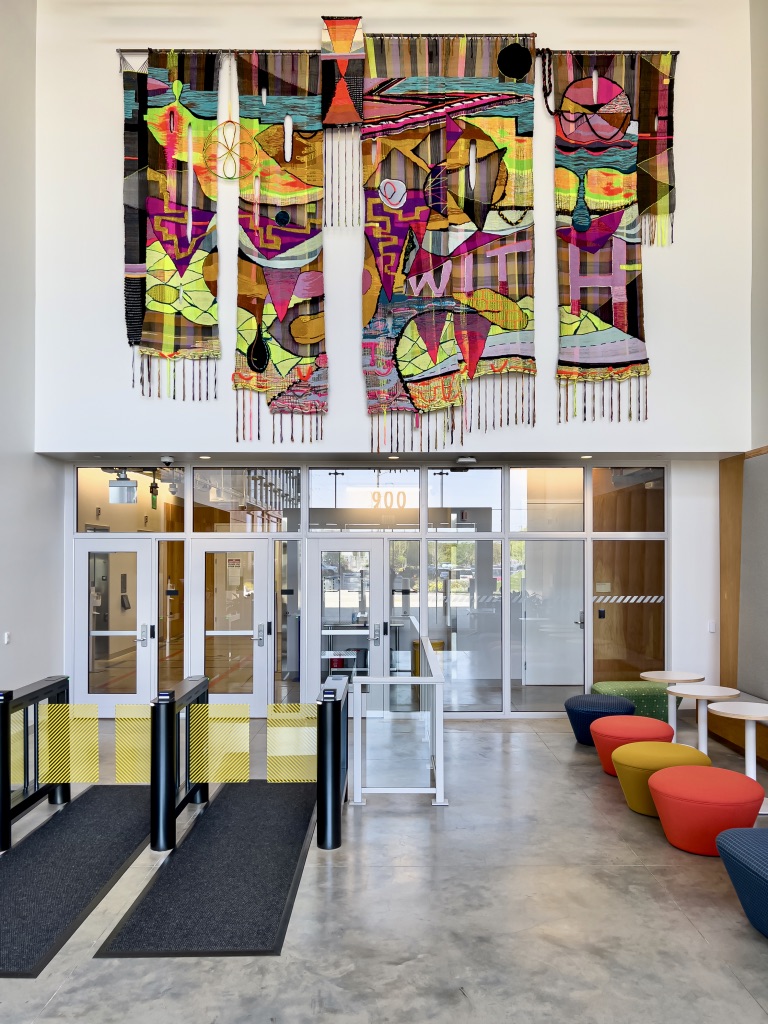
Terri Friedman, WITH, 2021. Facebook AIR, Virtual Reality Building Lobby, Sunnyvale, CA. 15’ x 20’. Photo courtesy of Terri Friedman.
In October 2021, I installed a large woven mural in the lobby of Facebook’s Virtual Reality building in Sunnyvale, California. The project took 6 months to complete and install.
Initially I proposed to Facebook a wall that said “wake up” with words in it like Pravda (“truth” in Russian). But it wasn’t the message I wanted to give the employees. That was for the company. And, the employees had to see it every day. As much as I had an impulse to lecture Facebook about their practices, I decided to make a more empathetic and loving message for the actual people who worked in the building.
I’ve been really interested in prepositions. They are relational and transitional. Open ended and generous. Leaving the narrative up to the viewer. They can tell their own story rather than be lectured to viewers. WITH = inclusion. Not apart from us. Your pain is mine. Relational. Community, care for each other. You are not alone. WITH is equitable. It is not above or below. WITH is about care and community.
Sister Corita Kent’s posters enlisted text, abstraction, and color to explore topical content and war. I enlist some of the same strategies. My weavings are my own somatic expressions of compassion and care.
My work chronicles the world around me with fiber. I explore those places where the political and emotional bodies intersect. I am buoyed by an ethos of optimism. Weaving is medicine. As I weave, I envision my works as salves or remedies for the ailments around me. When I created “With” for the lobby of META, I imbued it with the concern for the wellbeing of the people who would be experiencing it.
—Terri Friedman, 2022