
Rachael Schwabe: When I visited your work in person, I was blown away by the scale of your pieces and your use of different, various materials. Where and when did you learn to weave?
Kira Dominguez Hultgren: We were in Argentina for about 2 1/2 years for [a] permaculture kind of building. Straw, Bale, Adobe brick, all that. We were in an area of Patagonia where a lot of NGOs came and did training workshops and that kind of thing in partnership with Argentine organizations. The people living there are the indigenous population Mucha... There's like some city centers like El Bolson, Body Loach is a few hours away, but then otherwise it was all out in the mountains.
At the time I described it like I happened to walk into weaving. But I was always weaving, sewing [and] doing things with my hands. [I did] tons of textile making activities throughout my life and so it's not like, oh, I just happened to walk in.
At the time I was like, "oh, I've never seen this before, this feels familiar and yet not." As I've reflected since, I spent some summers in Mexico growing up—my dad is Mexican—and we hung out with weavers. My parents were just the kind of parents that were like, "let's go visit the [workshop of this artist] this artist [we met] in town while we were buying groceries." Then, as an adult when I was living in Argentina it took.
Along with doing permaculture building, I was collecting stories and interviewing people. While I was talking with these women in the workshop, one of them was like, “Well you can start cleaning wool for us as we talk,” and, “Well while we're talking, you might as well spin some wool.” Then, “you might as well dye some wool” and it like went on and on until over a year later, it was like, well, “we feel like you're ready to learn how to weave.” So I started weaving and it was [as if] all this language and ability to communicate with the material had been germinating, if you will. Over this year of talking and learning all the kinds of relationships with the material way ahead of ever approaching [the loom]. Then this next step of putting the material under tension, putting it on a loom. And this was all without any kind of written instructions. It was all oral and that was wonderful.
So, then it was like, "alright, we're going to teach you how to use this or move with the material [and] listen to the materials." The way they talked about it as [the way] you go along and what patterns are being drawn out of you. Why do you want to go [in] that direction and not necessarily “why” with an answer, let the patterning and the material guide you and communicate.
There were practical reasons why there weren't patterns books—[they] were insanely expensive. Paper was hard to find. Plastic was hard to find. Argentina doesn't have a relationship with China. So a lot of the goods and materials that are so easy to come by in EU were impossible to get down there [in] super rural Argentina. A lot of the times people just made do with the supplies that they had and that was amazing because for me I was realizing “I'm having a super sort of transformative…pedagogical experience.” Once I had had this experience I wanted to keep going. We decided to come back to the States [because my partner] was a grad student at UC Berkeley. I kept weaving because I was like, "Oh my gosh, I miss like I miss this experience so much."
I would weave a saddle blanket for a horse that I would wear as a skirt. People would see me on the street and be like, “Oh my gosh, like you learned that, or you're part of so and so's loom workshop. We can identify the hands that guided yours into whatever you're wearing.”
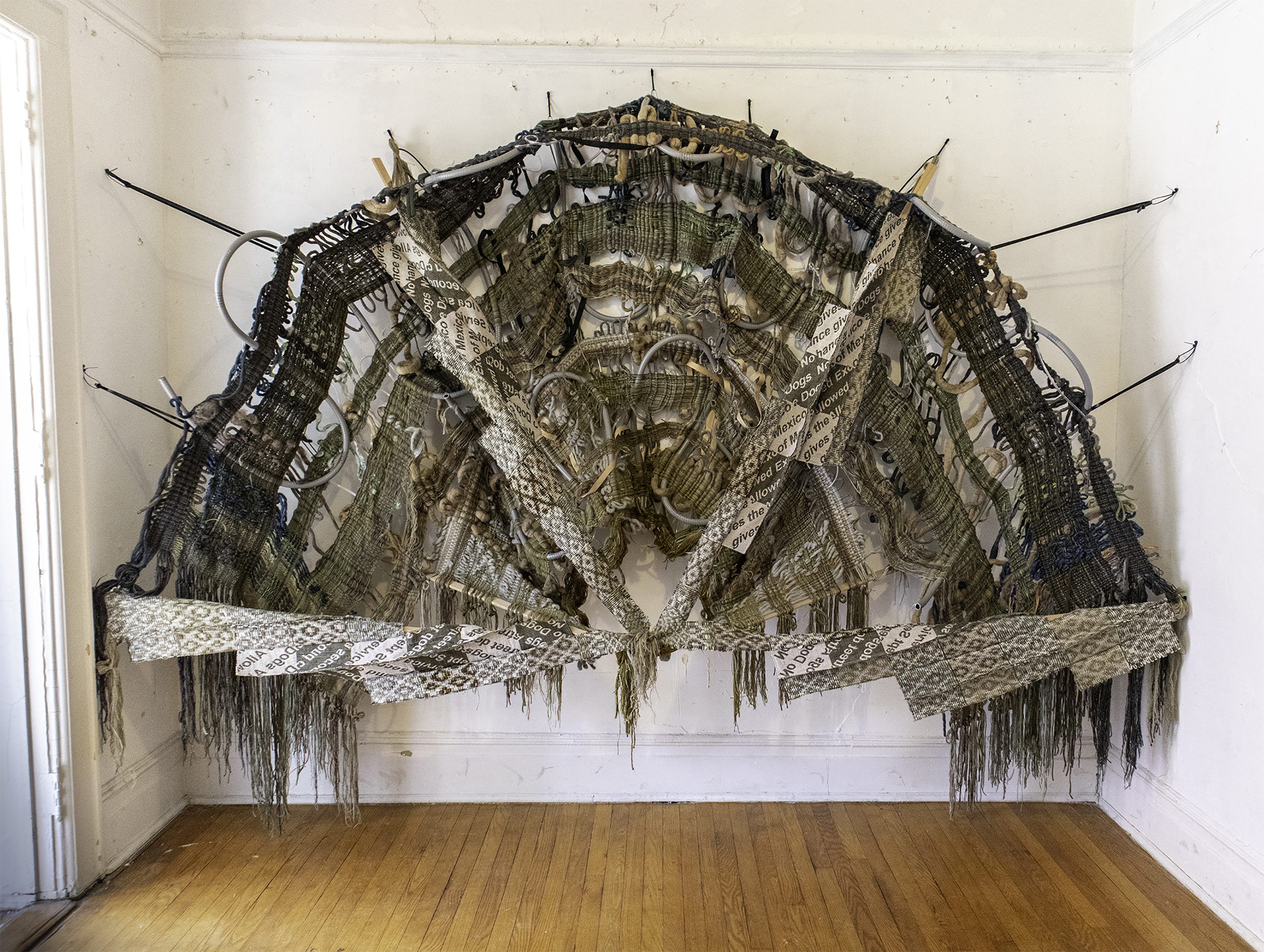
Kira Dominguez Hultgren, No Dogs Allowed, 2021. Loomed fabric in double-cloth, overshot, and warp-faced plain weave. Nonmetallic conduit and other plastics; wool, silk, cotton, linen, and other yarns; oak trim; leashes. 95" x 127" x 20". Photo courtesy of Kira Dominguez Hultgren.
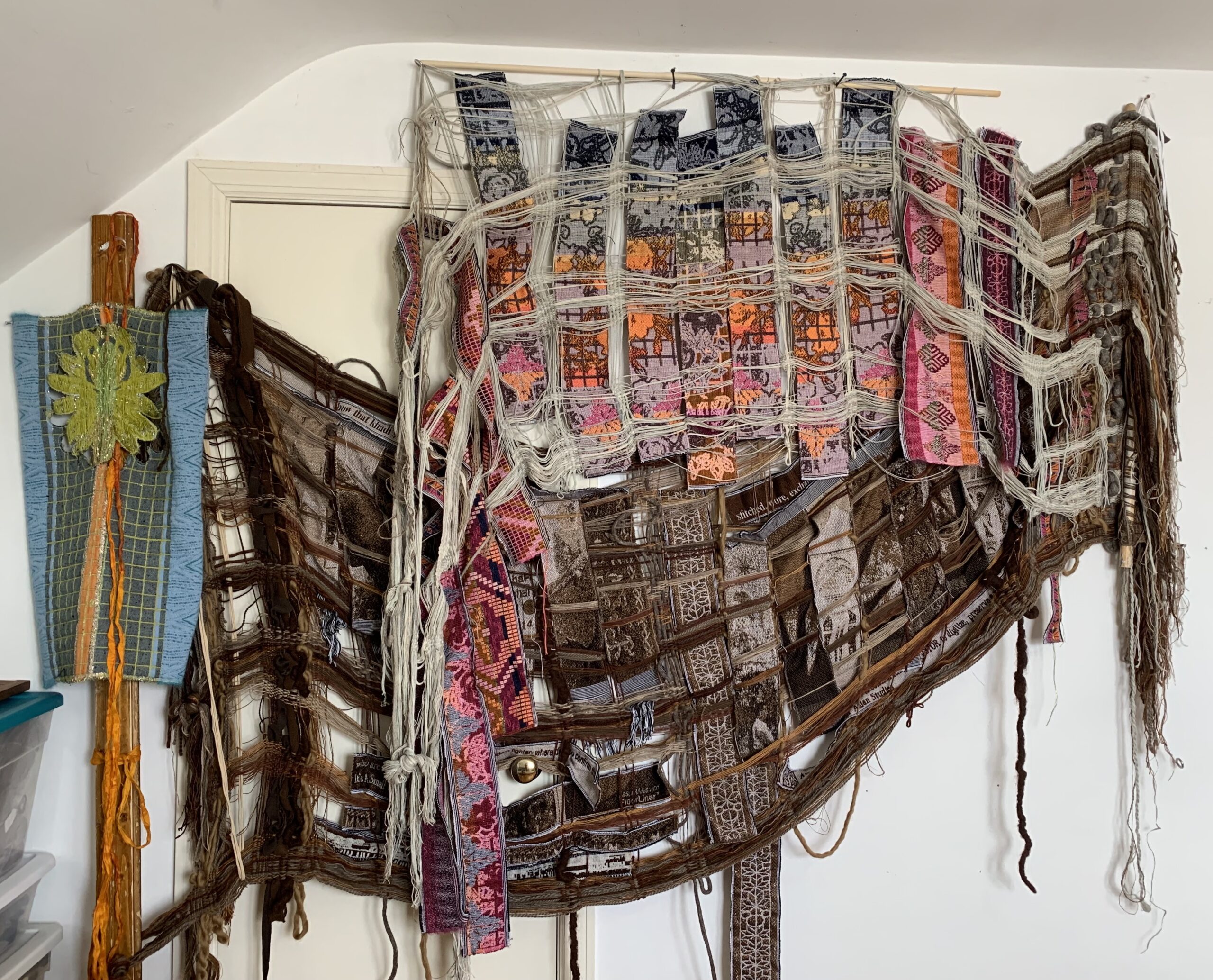
Kira Dominguez Hultgren, I was India (the palm tree remix) [In Progress], 2022.Mom’s Khadi (woven imagery and text from Disneyland’s “It’s a Small World” ride opening ceremonies in 1966 and other screenshot family histories in wool, silk, linen, cotton, acrylic, and metallic thread; loom bars); The Last Rose of Summer (digital-hand loomed chintz and pixelated phulkari motifs in cotton, linen, mohair, silk, and metallic thread; loom bar); Palm Trees on the Y-Axis (jacquard woven polar and Cartesian coordinates in mohair, cotton, wool, and metallic threads; appliqué mirrors; reused sari silk; loom bars). 84” x 96” x 6” (variable). Photo courtesy of Kira Dominguez Hultgren.
RS: It's interesting to hear you talk about how people could identify the hands who made a particular piece, because I think pieces also transmit specific messages through their materials. I get the sense that you treat your materials with a lot of empathy, and I wonder if you feel that way.
KDH: Contemporary weavers are very like keyed into the ways that wool and cotton and fibers can accept color. Dyeing is a big part of the way that weaving is done. And usually then [not necessarily] towards like photorealistic imagery but sometimes abstract imagery, paying a lot of attention to the ways that they can have control over color and color blending through weaving. I was interested in thinking about the ways that materials have this life or this biography before I'm ever touching it. It was important to me the way that I was sourcing material in Argentina: "oh, I know so and so has this color sheep." And it's the equivalent to me of going into local yarn stores wherever I am and being like, "oh so and so is working here." To me, it's an urban way of foraging and sourcing material and once I'm using it, it's important for me to watch the way it's interacting with all the other materials that have been gathered. Like the way a really thin silk interacts with like a thicker kind of paper linen, with a very coarse wool, and how can they all work together. And I can't really get to know any one of them without seeing them in interaction with everything. I'm constantly lining up the warp with as many different kinds of materials I can because it's like seeing, [or] it's like getting to know somebody in different contexts—you see who they are. It's the same thing with the material.
RS: I work also as a writing tutor at one of the schools I teach at. In talking to students about their writing they…always have comparative papers [and they come in] hoping to edit them. Recently I was like, oh, you know what? Comparisons really are useful because [in] examining [two things] together it helps us to see them individually with more clarity.
KDH: Yeah, that's a great way to think about it. [I’ve] never thought about it that way.
RS: I notice a lot of people have a lot of consciousness around the materials that they use and the dyes they're using. There's a real emphasis on not just the total structure, but on its individual pieces and parts and how they create like a whole. My favorite piece [in your show at Hero Gallery] was one you had felted, and it also included some of your hair?
KDH: Yeah, well it’s interesting. Hair [has a] way that it clings to textiles to any kind. [For] wool especially, it's impossible to not kind of have your hair embedded into it, whether you want it to be there or not—it just picks up everything. Often when I was spinning—and I have long hair—it would get caught up in the wheel. And I'd be like, "oh, I can try to get it out, or leave it [because] no one's going to see anyway." [With] that piece it was like, "well like, let's just like make it a little bit more obvious," especially with felting because it [is] such a matted kind of like structure.
RS: Yeah, felting is such an involved process.
KDH: That’s part of the reason why I love to weave and felt more so [than knitting and crocheting]. I mean, I really do love knitting and crochet, but it has not worked its way into my art practice as readily, mostly because I love the sort of physicality of felting and weaving and being required to hold so much intention at once.
RS: In your work in particular your pieces stretch and reach and span. They just strike me as being such embodied objects that carry your presence in multiple ways. What do you think about when you're weaving?
KDH: I feel like weaving gives me a space to think about everything in some way. It orders all the thoughts that are already in my head. If I'm feeling overwhelmed, the easiest thing is to just sit down and weave. It creates a lot of a lot of space to watch things evolve really slowly. I usually spend an inordinate amount of time just staring at the material. I am not ashamed to be like, "I definitely have a material fetish here"—it's not hard for me just to have like hours trip by and not even realize [it].
It depends like what kind of weaving I'm doing. Sometimes it's just a very repetitive process, it's like walking—that way you can kind of zone out. And other times it's like I have a lot of decisions I'm making constantly as I'm going because I'm changing color, I'm changing direction. I'm doing a lot of discontinuous, technically tapestry weaving and that's asking my brain to kind make decisions as I go along… Sometimes…I don't want to overthink it too much, and allow the material to be like, “actually, I think it might be better to go this way or that way.” I have a lot of written plans that I often discard as I go along. It's constantly changing. I watch what I do and take notes and then go back to it. I [also] listen to audiobooks and depending on what I need to be thinking about sometimes like I'll try to find some theory and sometimes I'll just be listening to fantasy novels.
I usually have my loom in the living room where my family [comes] in and out. I can like interact with them as I'm going along with the process too, because I have two kids and especially when they were little, it was important that I could take a step back and do whatever needed to get done and then go back to the loom.
RS: That’s such an accurate description of creativity at work, where your brain is working at two different registers, one register where you're thinking about what's happening and then another like register where you've distanced yourself and you're just kind of letting things unfold—and you’re doing both somehow at the same time.
KDH: Yeah.
RS: You're both within yourself and outside of yourself as you're as you're making something.
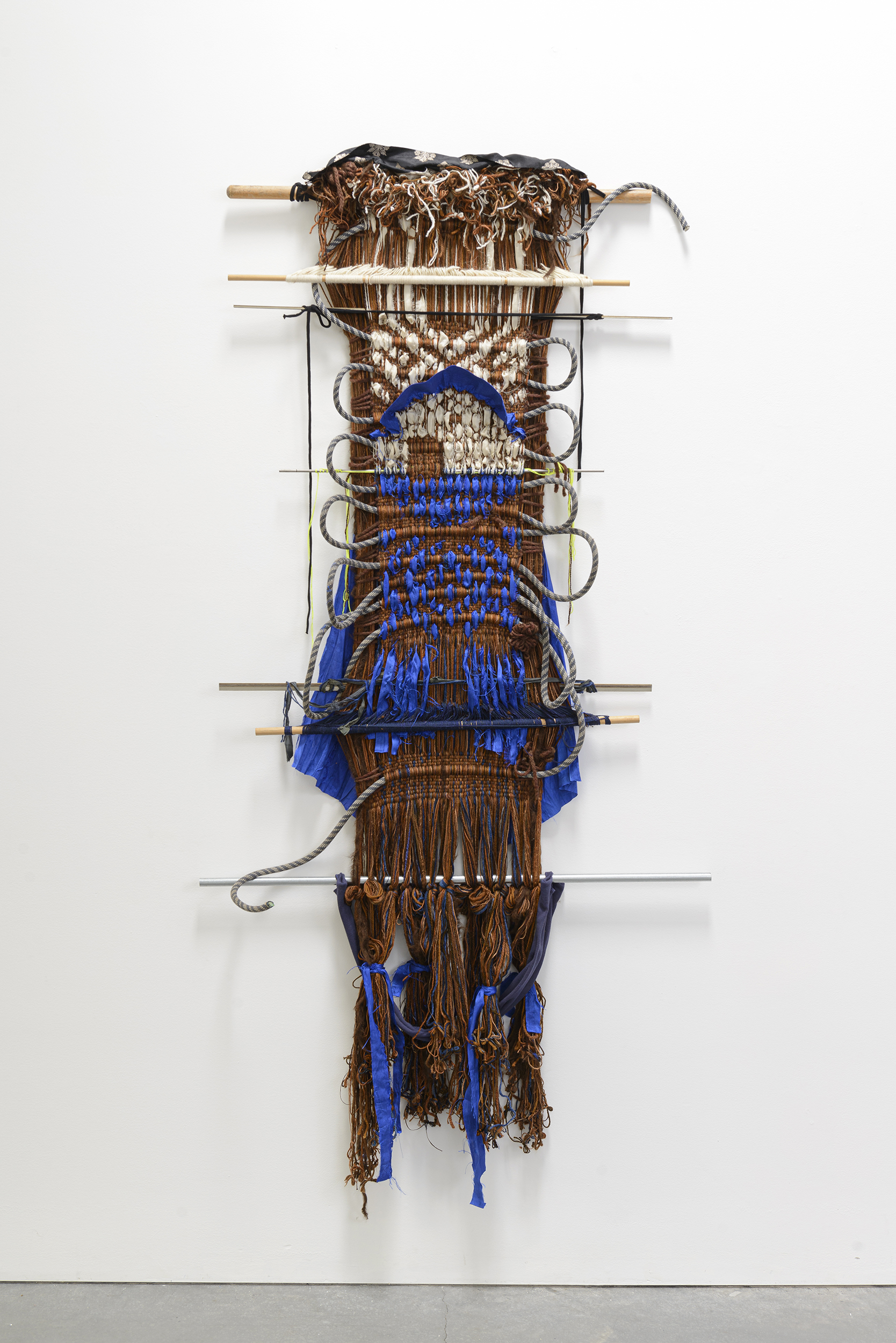
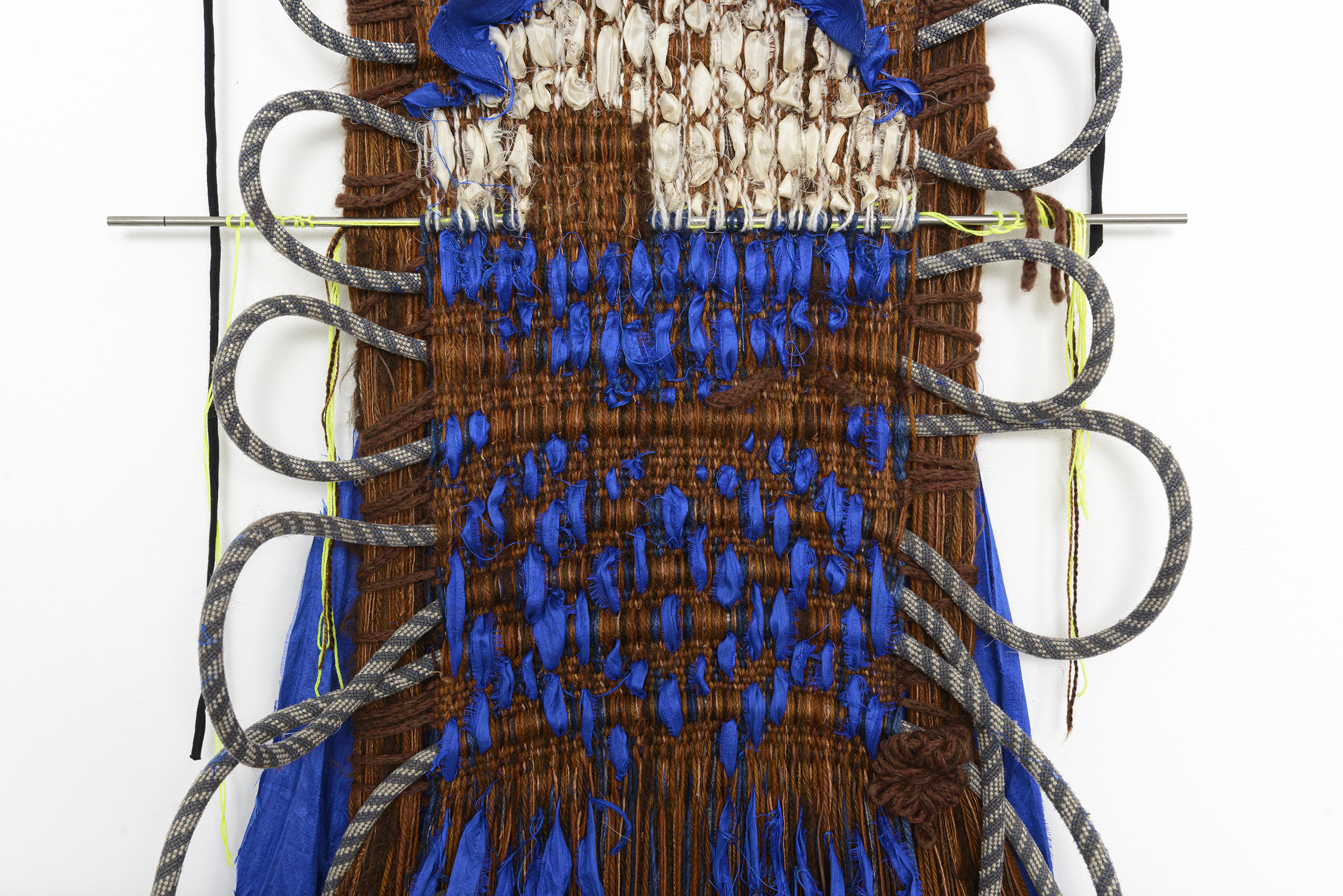
Kira Dominguez Hultgren, Horizon Lines, 2020. Discontinuous embedded substitutional warp-faced double weave with found wood and metal loom bars left in place; silk from artist’s grandmother’s and artist’s own childhood Punjabi suits; backstrap in cotton jersey sourced from India and Joann’s fabrics; climbing rope (Berkeley Iron Works); hand/machine spun yarns in wool, alpaca, silk, acrylic, and other novelty fibers. 86” x 42” x 7". Photo courtesy of Kira Dominguez Hultgren.
RS: I'm wondering what your overall, general relationship with empathy is and what does it really mean to you?
KDH: I'm pretty introverted. I can be very lively but it's hard for me to just have like tons of friends. I think one of the reasons for that is because I'm prompted by what's around me. So, material emotions in some ways are way more controlled and easier to like handle than people emotions. Obviously, people are super complex, and they bring—at least the way that I'm feeling—a whole history with them into a room. With materials it's easier to sort of discover that process, maybe with less variables and maybe at a slower pace. It asks less of my own thoughts. It allows me to kind of make more mistakes. [Weaving gives] me space to not necessarily fix the problem because I don’t love going back and fixing anything.
This idea of not even necessarily fixing, but, alright, you've presented a different kind of problem for me to now step through and see what it brings out of me. [What’s it going to] prompt and the more time that I spend with [the] process with people, I feel like it brings out different sides of who I am and the things that I'm noticing or I'm drawn to. And so then I bring that into the next interaction. An empathetic process with materials [is] an understanding that pieces or materials, especially maybe moments of peace really prompt the way that I begin imagining or thinking or approaching the next piece.
RS: In talking with another friend of mine for this project, we ended up talking about how art can help us unlock or access different parts of ourselves or different emotions that we wouldn't otherwise be able to access totally on our own. And I think that your relationship with materials is so fascinating because of the intimacy, but also the way that you work together and help each other.
KDH: Yeah, I feel like a lot of the structural processes that I'm really drawn to help me organize the way that I move through the world. Some have lent themselves to helping me think through how to have a conversation between what it is that I'm interested in when I approach [a] material and what the audience or viewer or a gallery is sort of seeing and what they're interested in.
Webbing, for instance, is one [material] that I like to work with. [It’s] a lot like sort of seat belt material, right? And the way that we use straps or ropes. How do we use ropes? How is it made? And so how can I take things, especially a lot of fibers that are made at such a like micro scale and blow it up in a way that I'm following the same structure and motions that the material [embodies] at a tiny scale. That's a way that somebody who may be familiar with this material as a seat belt can now like see it as a woven belt and be like, "Oh OK, I get it," [to help them] understand the ways that their body's relationship to that material is very different. But actually the structure is kind of lending itself—it's the same structure, just used in totally different contexts, and so it can give people an idea of how to let their body approach what it is that they're seeing.

Kira Dominguez Hultgren, Both Sides Now, 2022.Handwoven mohair, wool, cotton, and metallic threads; appliqué mirror; polar coordinates rendered in Desmos (r=10csc((θ+9)(cosθ)) courtesy of artist’s son. 28” x 28” x 3”. Photo courtesy of Kira Dominguez Hultgren.
Frictional empathy, frayed assemblages, might be the way to talk about these weavings. I don’t think I can recreate or understand any of my family’s lives, but I can live through/with/in their experiences on the loom, feel the contradiction, feel the tension.
One work, or body of work, that I’m just getting started on is a weaving/embroidery project pivoting from the phulkari embroidery weaving that I did in 2020 called Arose. In these pieces, I’m using polar coordinate equations (lines that go in opposite directions at specific angles and distances from any given center point) that my son rendered in the open-source platform Desmos.
While I don’t quite understand the way my son was using these equations for precalculus, I can’t help but look at them and see the way my great-aunt was stitching around a single point on the khadi cloth to create the embroidered phulkari flowers. Polar coordinate roses moving into and out of phulkari stitches. Although these aren’t physically cut into and rewoven using family and community fabrics, I’m conceptually and physically interacting with the ideas and motions of stitch work, of creating lines. I can feel into the tension of now becoming a center point for multi-directional generations (my great-aunt to my son) moving me, shaping me through their life-lines.
The viewer is invited into this conversation first in the scale of these pieces. I ask the viewer to negotiate the shapes of these lines in relationship to their own bodies. But also, I’m hoping that the tension I feel through my family stories, may give the viewer a way to feel out their own stories, their own ways of being created through lines and ends that are torn, frayed, and moving in seemingly opposite directions from themselves.
—Kira Dominguez Hultgren, 2022