Deeply understanding another person or living being by contemplating their unique perspective, life experience, and emotional state; listening to another person or listening to nature with openness; taking on another’s point of view and sharing their feelings; acknowledging a multiplicity of ways to be alive and part of the world that are different from one’s own choices and experiences.
What feelings do you associate with the word, “empathy”?
If I am receiving empathy from another person, I feel care, love, compassion, connection, and a sense of relief. When I am the empathizer I also feel care and compassion, yet I am aware of my stress from a sense of inadequacy: that I may ineffectively communicate that I am understanding of the other person’s experience and share their feelings and pain.
How do you show or communicate empathy?
I listen and understand and try to deeply connect with someone’s experience and their emotional state. I communicate through words, eye contact, facial expression and gesture, and touch if it is a family member or close friend. I acknowledge what they are going through with openness and without judgment as much as possible. I try to figure out what’s wrong and if there is anything I can do to relieve their pain at that moment or beyond.
How might you describe the difference between sympathy and empathy? Are these two sensations different?
I think of sympathy as concern for another person, but it might not require meaningful understanding about a point of view or life experience.
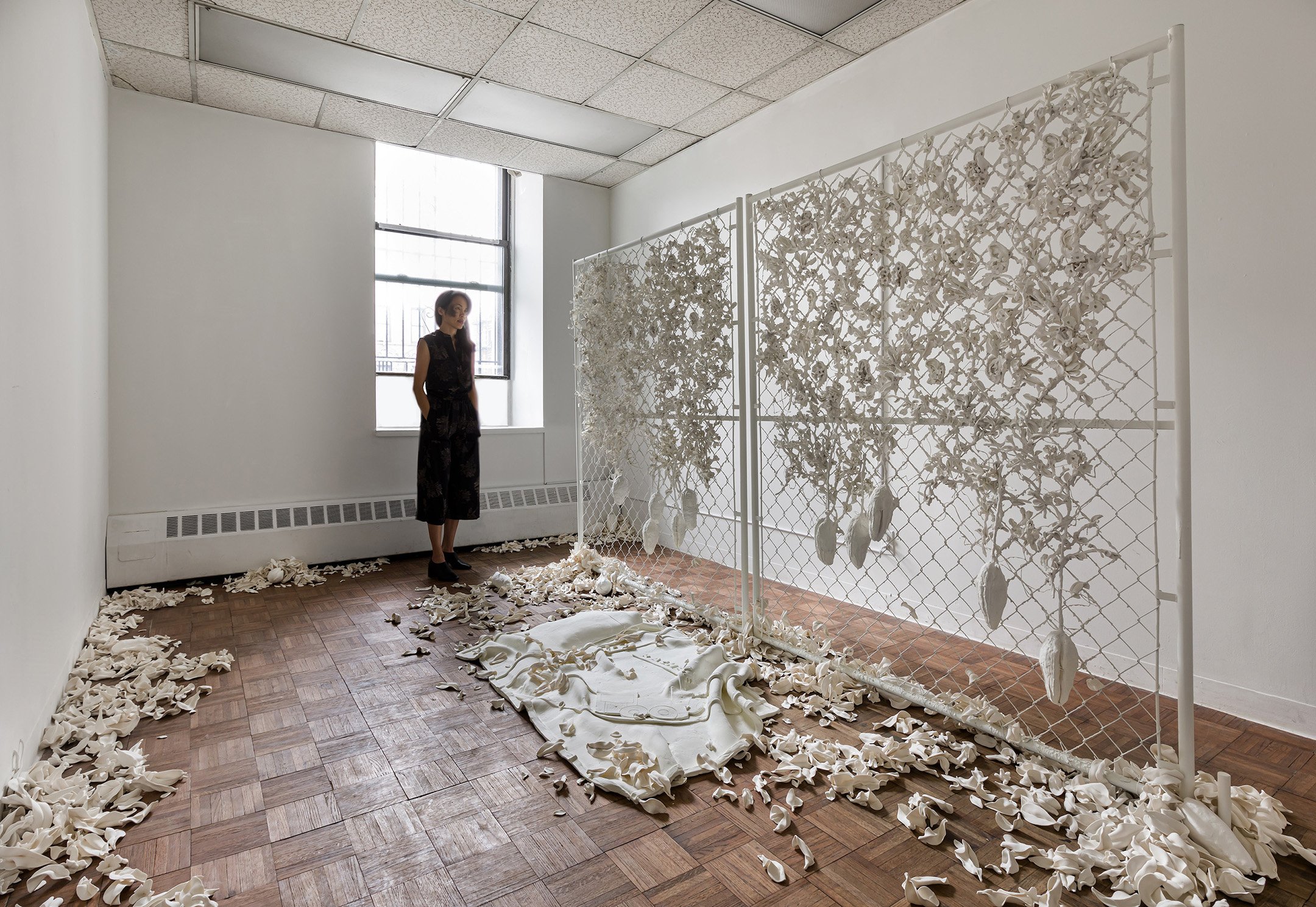
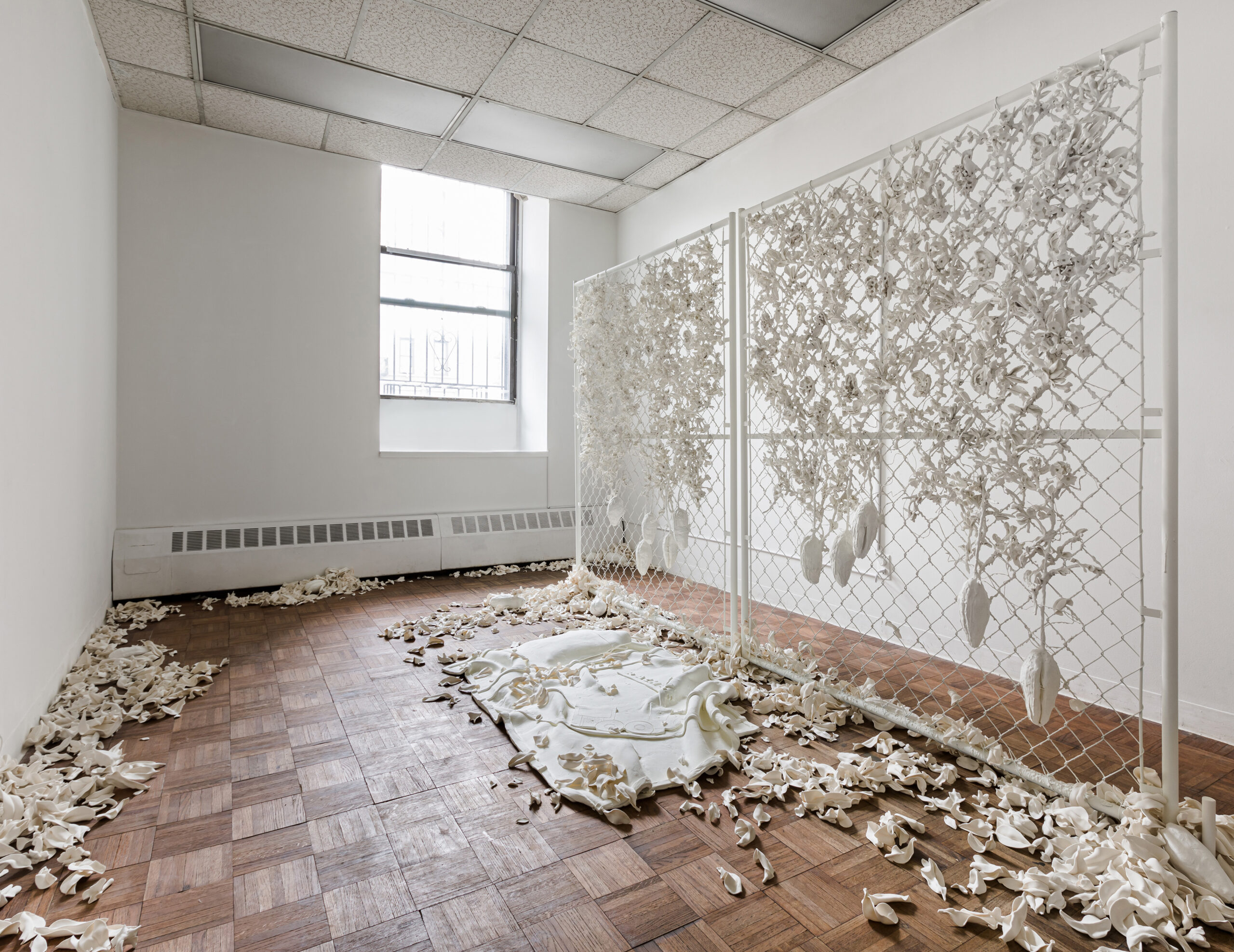
Rachelle Dang, Under a Constellation of Leaves, 2019. Aluminum fence panel, air-dried clay, wire, Aqua-Resin, polyurethane paint; 6 x 10 x 14 ft. Photo credit: Etienne Frossard. Photo courtesy of Rachelle Dang.
I teach and am in weekly dialogue with undergraduate and graduate students through studio visits, meetings, impromptu conversations, critiques, and class discussions. I interact with nearly 70 artists per semester; each one has a unique and ever evolving voice and viewpoint, and different life experience. I’m engaging with the person, their ideas, their artwork. I listen and look, and I try to understand the path they want to be on with their work. I recently began teaching at a different institution and have many teenage students, more than my prior undergraduate classes at another university. When they confide in me about their challenges and feelings, I try to reflect on the emotions I felt at the same age, yet also relate to them person to person, balancing my roles as teacher, mentor, confidante, and as someone they trust who might understand where they are coming from. A first-year student shared with me, while crying, that she felt no joy in anything in life. I remembered times when I felt something similar, and I listened when she told me what was not helping, including therapy and even friendship. I suggested something that made her smile a little and she nodded that it was joyful: eating something delicious. The second joyful thing would perhaps sustain her creativity and inner self: some free time to get off campus and take a daytrip to New York City. She mentioned she felt nothing while drawing in our class; she did it rote. By the end of the term, I had a better sense of her interests and what she might need at this moment in her life, and I suggested a documentary film class which caught her attention and she enrolled.
What do you turn to when you’re looking to feel something/empathy?
Nature. Quietly walking alone, under the trees or near the ocean.

Rachelle Dang, Under a Constellation of Leaves, 2019. Aluminum fence panel, air-dried clay, wire, Aqua-Resin, polyurethane paint; 6 x 10 x 14 ft. Photo credit: Etienne Frossard. Photo courtesy of Rachelle Dang.
Describe a making process that you have. Has there been a time when you wanted to make, or infuse an object with sentiment? Can you think of a time when empathy was a part of your making practice? Has there been a time when empathy has been a part of your craft process or product?
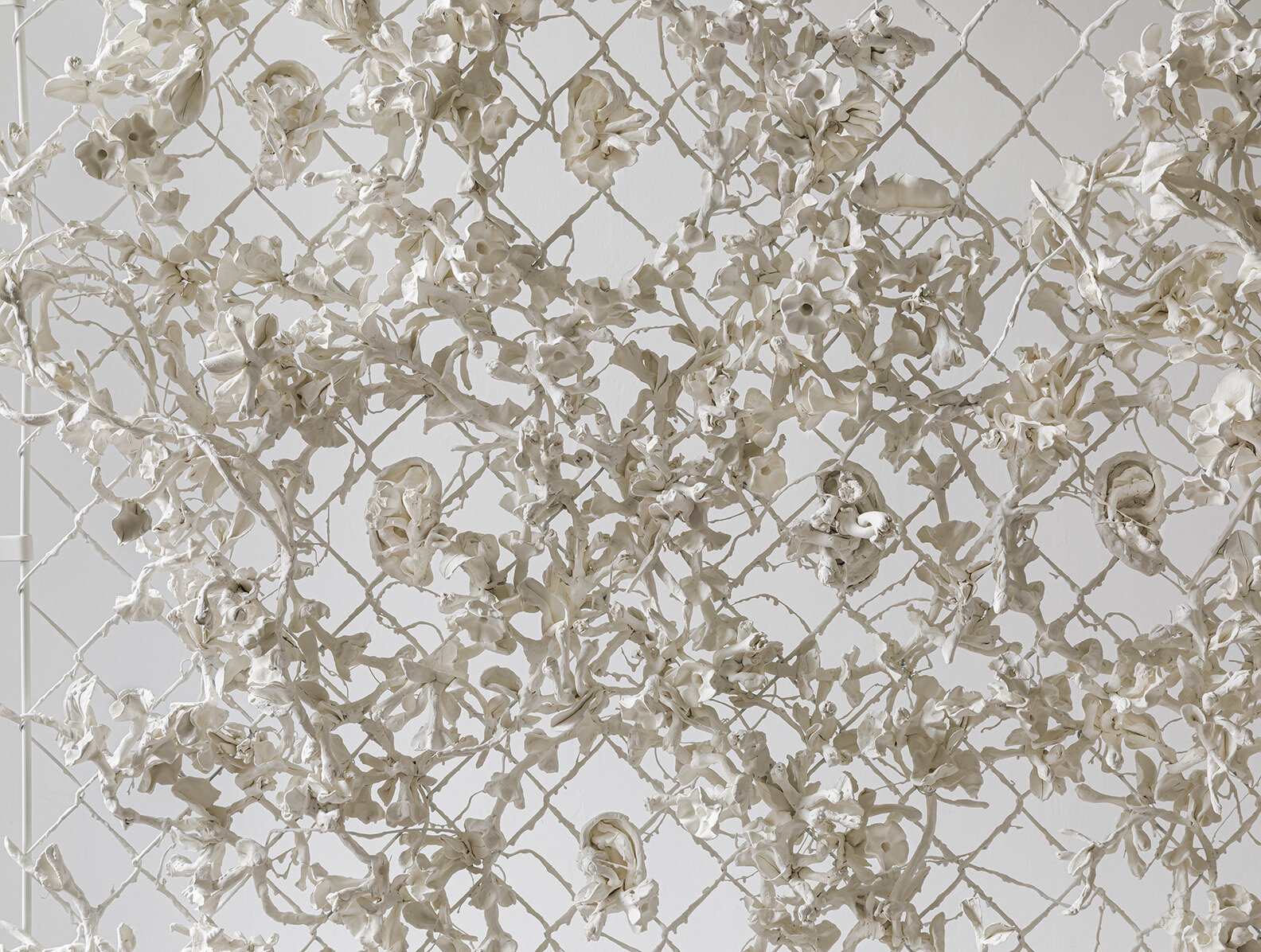
When I shape the natural forms in my work by hand, such as the leaves and vines, I meditate and focus on memories of seeing and enjoying the aliveness of plants and trees, their suppleness, their movements, and the unique dimensionality of these living things. I typically have a photo reference somewhere in the studio, but it’s my experience of things alive that matters: something growing, responding to the elements, at any stage in a life cycle. The material I have used – a type of air-hardening clay – allows me to shape forms that are extremely thin (1/16th or 1/8th of an inch), with a noticeable suppleness and swelling. These voluptuous shapes resemble the body, and viewers have suggested lips and tongues. The resemblance to human form evokes tenderness and vulnerability; the material also seems fragile although it is quite robust. Under a Constellation of Leaves (2019) is an immersive work comprised of nearly a thousand forms shaped with this material. Using an aluminum chain link fence spanning 10ft, I covered the fence in a thick mass of sculpted vines, and placed at its base a hand-shaped clay replica of the sleeping bag I used as a child that my mother designed and sewed. I placed hundreds of sculpted leaves around the fence and sleeping bag, and along the walls of the gallery. The clay material is white, and the vine-covered fence was spray finished with a matte white automotive paint that suggested unfired or unglazed porcelain. It seemed, even to my eyes, that if one were to touch the fence it would shatter. The visitor experienced the intertwined vulnerabilities of nature, childhood, and material. I created the fence and its stephanotis vine to resemble the backyard of my family’s home in Hawai`i, where I grew up. To make this work, I thought about the life energy of the plants and trees growing around our home, and the loving tenderness of my mother’s gesture. The sleeping bag was like a cocoon that protected me while away from her, in preschool and kindergarten. In this installation there is an inescapable feeling of sadness and loss. For me, the white color suggests bone and bleached coral exposed at the beach, as well as the fragility of unfired porcelain as some kind of labor that could go to waste at any moment. I also associate white with the color of mourning; in the culture of my Cantonese ancestors, it is customary to wear white at funerals.
Describe an object in your life that is a touchstone for empathy. How does it perform empathy for you?
I don’t know if I have one; I haven’t previously considered a touchstone for empathy. What might come closest is a “five-year diary” I keep, I’m nearly finished with my second. This type of diary has 365 pages, and each page has five entries: I write a brief paragraph on the day and indicate the year. On the same page I am able to read prior entries from one to four years ago. It’s beautifully analog: I notice my handwriting from previous years and if a lot happened my notes will have run into the margins, along the gutter, and over the lines reserved for the following year. I think back to friends and acquaintances I spoke with on that day, and recall kind gestures and lovely or sad things. My intention is not to write to a future self, although there is the benefit of preserving memories. Most important is meditation on the day that just ended, and allowing myself a few minutes to reflect on feelings and experiences. When I started diary-keeping nine years ago, I wanted only to write positive things, but each day I felt compelled to recognize and acknowledge a range of thoughts and emotions, whatever they might be. Maybe this daily practice helps a little with empathy, because it frames a moment to contemplate feelings and the world I am part of.